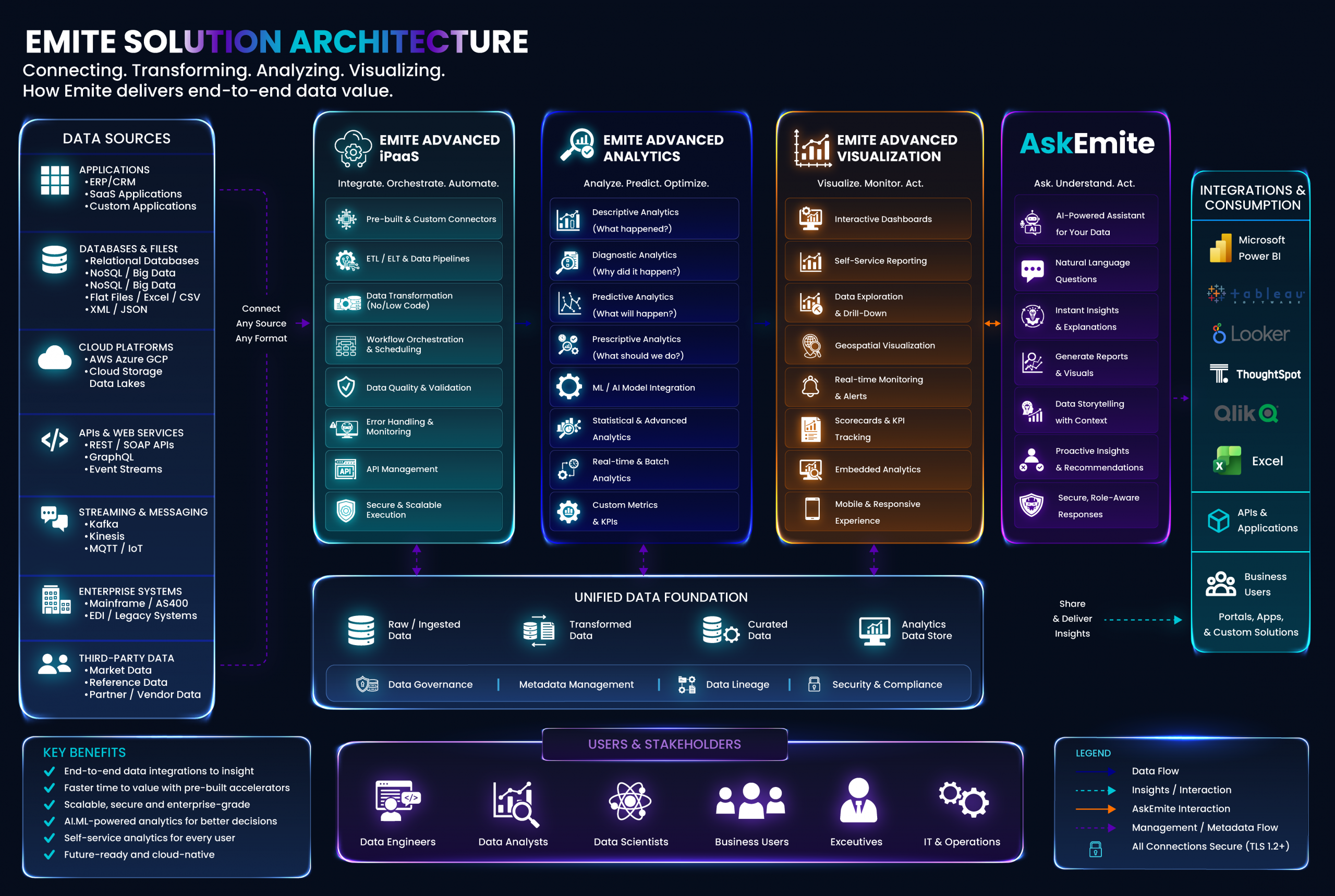
What is emite Advanced iPaaS?
emite Advanced iPaaS is a connector-less, event-driven integration platform that unifies enterprise data in real time across APIs, databases, cloud platforms, streaming services, and on-premises systems — feeding a single, governed, analytics-ready data foundation.
What does “connector-less” mean?
Instead of relying on a catalog of prebuilt connectors, emite points directly at any HTTP endpoint, REST API, database, stream, or file source. You’re never blocked waiting for a vendor to build a connector, and there’s no connector version maintenance.
How is emite different from other iPaaS Platforms?
Traditional iPaaS platforms are connector-based and stop at integration — you still need a separate BI stack. emite is connector-less, event-driven, and includes analytics and visualization in the same platform, taking you from integration to insight in one governed flow.
What sources does emite connect to?
REST APIs, HTTP endpoints, JDBC databases, Amazon S3, Kinesis, Kafka, EventBridge, webhooks, and file drops — plus SaaS platforms like Genesys, Amazon Connect, Salesforce, and ServiceNow, including multiple instances of the same platform.
Does emite support real-time and batch integration?
Both. Event triggers stream data continuously in real time, while scheduled batch updates support systems that refresh periodically — covering operational and analytical workloads.
Do integrations require coding?
No. Integrations are built as logical groupings of configurable Actions — created, tested, versioned, published, and rolled back through configuration rather than code.
How does emite secure data in motion?
With encryption in transit and at rest, role-based access control, audit logging, data segregation, fine-grained document-level security, and triple-lock authentication at source, in flight, and at persistence.
Can emite coexist with our existing warehouse or BI tools?
Yes. emite complements existing investments — it can feed or receive data from warehouses, BI tools, and middleware, supporting a modular, high-velocity data architecture.
What ROI can we expect?
Organizations using emite typically report reduced integration development time, lower licensing and storage costs, and faster decision cycles — improving customer outcomes while lowering total cost of ownership.
What happens when our tech stack changes?
Because emite is connector-less and API-driven, new systems can be integrated rapidly without re-architecting existing flows — keeping your integration layer future-proof.