BLOG

The Contact Centre in 2026:
More Pressure, Less Margin for Error

Contact centres are managing more complexity than ever, fragmented data, rising customer expectations, AI pressure, and a workforce under strain. Real-time intelligence that actually drives decisions is no longer optional. AskEmite was built for exactly this moment.

Contact centre leaders are navigating a convergence of pressures that would have been difficult to predict even three years ago. The mandate to implement AI is real and urgent. The expectation that human agents will continue to handle the interactions that matter most is equally real. . And sitting underneath both is a workforce and data infrastructure that, in most organisations, was not designed to carry the load now placed on it.

The result is a sector caught between ambition and execution. The technology exists to transform customer experience and operational efficiency. The data foundation required to make that technology reliable often does not, or exists in fragments, spread across systems that were never built to talk to each other.

Before exploring the solution, it is worth being precise about the problem. There are four distinct pressures converging on contact centre operations right now, and they interact with each other in ways that make each one harder to address in isolation.

91%

of service leaders under executive pressure to implement AI (Gartner, 2025)

30%+

average annual agent turnover, twice the rate of other industries (NICE CX Workforce Report, 2025)

7%

of contact centres deliver truly seamless omnichannel transitions (CMSWire, 2026)

4x

more investment in data foundations separates AI success from AI failure (Gartner, 2026)

Four Pressures Every Contact Centre Manager Recognises

1. The AI Implementation Imperative, With No Clear Playbook

The pressure to implement AI is not coming from the technology team. It is coming from the board, from the CFO, and from customer expectations that have been reset by the best AI-powered experiences in any industry. 91% of customer service and support leaders are now under executive pressure to implement AI, not just for cost reduction, but to directly improve customer satisfaction (Gartner, 2025).

The problem is that the path from AI ambition to AI value is not well signposted.

Gartner predicts that 40% of agentic AI projects will be cancelled by the end of 2027, not because the technology failed, but because success requires a level of data governance, process clarity, and operational readiness that most organisations have not yet built.

Contact centre managers are caught in the middle. They are expected to adopt AI, demonstrate ROI quickly, and manage the operational risk of getting it wrong, often simultaneously. The playbook for doing all three is still being written.

“Success in 2026 will not be about deploying more AI. It will be about deploying AI with purpose, ensuring every capability has a clearly defined role, solves a specific problem, and is measured by real outcomes.”

— Gartner, 2026

2. Retaining Human Expertise While AI Changes the Role

The question of what happens to human agents as AI scales is not theoretical. It is already reshaping workforce planning, hiring decisions, and the nature of the agent role itself. 85% of service and support leaders are expanding human agent responsibilities, not eliminating them (Gartner, 2026). But the role they are expanding into is fundamentally different: more complex, more consultative, and requiring a different kind of support.

The agents handling the interactions that remain, the escalations, the complex queries, the high-stakes moments, need better information, faster. They cannot wait for a supervisor to pull a report or a data team to run an analysis. The intelligence they need has to be available in the moment, in a form they can act on immediately.

This is compounded by the turnover reality. Average contact centre attrition runs above 30% annually, twice the rate of other industries, with burnout from tool sprawl and cognitive overload cited as primary drivers (NICE CX Workforce Report, 2025). Every experienced agent who leaves takes institutional knowledge with them. Rebuilding that knowledge in a new agent takes months. Organisations that cannot surface operational intelligence quickly are disproportionately exposed every time a skilled team member walks out the door.

The Hidden Cost of Agent Turnover

The direct cost of replacing a contact centre agent, recruitment, onboarding, training, is estimated at between 50% and 200% of annual salary. The indirect cost, lost institutional knowledge, service quality dip during ramp-up, team morale impact, is harder to quantify but consistently reported as the more significant burden. Organisations where operational intelligence is embedded in systems rather than individuals are materially more resilient to attrition.

3. Fragmented Data: The Gap Between the Systems You Have and the Intelligence You Need

The modern contact centre runs on a stack of platforms that were not designed to work together. Workforce management. CRM. Quality assurance. Voice analytics. Ticketing. Customer feedback. Each generates data. Few share it cleanly.

The consequence is a performance picture that is always incomplete. A team leader trying to understand why CSAT dropped this week might find the answer sitting across three different systems, none of which surface it together automatically. The analysis takes hours. By the time it is complete, the moment for corrective action has passed.

This fragmentation is not just an operational frustration, it is an AI readiness issue. Only 11% of organisations report full integration between their operational platforms and CRM or business systems (2026 Digital Customer Communication Survey). AI fed into fragmented data environments does not produce unified insight. It produces multiple confident-looking answers that contradict each other, and undermines confidence in analytics across the board.

The data foundation problem is the contact centre problem that most directly determines whether AI investments pay off. And it is the one that gets the least attention when organisations are under pressure to show fast results.

11%

of organisations have full integration between messaging platforms and CRM/business systems (2026 Digital Comms Survey)

56%

of customers say they have to repeat themselves during support interactions (Forrester)

89%

customer retention rate for companies with strong omnichannel strategies vs 33% for those without (Forrester)

4.Omnichannel Expectations: Continuous Experience Across Every Channel

Customer expectations around channel continuity have been set by the best digital experiences in any sector, not just in customer service. When a customer moves from chat to voice to email, they expect the context to move with them. 75% of customers expect a seamless experience across all channels. Only a fraction of contact centres deliver it (McKinsey).

The gap is structural. Only 7% of contact centres currently deliver truly seamless omnichannel transitions, where context, history, and intent carry cleanly from one channel to the next (CMSWire, 2026). For the remaining 93%, every channel handoff is a potential moment of friction: the customer who has to repeat themselves, the agent who lacks context, the interaction that should have been a resolution and becomes a complaint.

Solving this requires more than a better front-end CX platform. It requires a unified data layer that makes the full customer history accessible across every touchpoint, and operational intelligence that lets managers identify where handoffs are breaking down before customers start telling them directly.

McKinsey is direct on the commercial consequence: real omnichannel strategies raise revenue by 10–15% and improve customer satisfaction by 20–30%. Companies with strong omnichannel execution retain 89% of their customers, compared to 33% for those with weak strategies (Forrester). The gap between those two numbers is the cost of fragmentation.

Why Real-Time Intelligence Is the Thread That Connects All Four

“The organisations generating the most sustained value from analytics are those where data-informed decision-making is distributed across the business, not siloed in a central function. AI is the mechanism that makes that distribution practical at scale.”

— MIT Sloan Management Review

Each of these pressures has a data and reporting dimension. They are not separate problems, they are connected expressions of the same underlying challenge: contact centre managers do not have fast enough access to the right information, in the right form, at the point decisions need to be made.

Deciding where to deploy AI and how to measure whether it is working requires live operational data. Retaining agents and managing burnout requires early warning signals, queue pressure, adherence gaps, quality trends, before they become attrition events. Fixing data fragmentation requires visibility into where inconsistencies exist and what they are costing. Delivering omnichannel continuity requires a unified view of the customer journey across every system.

Real-time reporting is not a reporting problem. It is an operations problem. The speed at which a contact centre can detect a signal, understand its cause, and direct a response is the most direct determinant of whether it stays ahead of its challenges, or perpetually catches up to them.

The traditional approach, dashboards that display data, analysts who interpret it, reports that arrive after the fact, was not designed for the operational velocity that contact centres now require. The gap between a performance signal appearing and a decision-maker acting on it has become a competitive disadvantage.


Introducing AskEmite: The Intelligence Layer Your Operation Has Been Building Toward

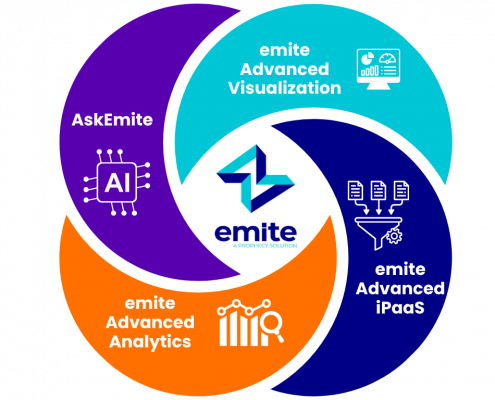
AskEmite is emite’s new AI intelligence agent, embedded directly in the emite Platform and powered by ProDataIQ, Prophecy’s AI and decision intelligence engine. It is the answer to the question that every contact centre manager, operations leader, and data specialist has been asking: why can’t I just ask what I need to know and get a straight answer?

That is now exactly what you can do.

AskEmite sits across the entire governed emite data environment, the same unified, trusted data that powers your dashboards and KPIs across 300+ connected sources. Rather than navigating reports or briefing an analyst, you ask a question in plain English. AskEmite interprets the intent, reasons across your data, and returns a clear, contextualised answer with recommended next steps, in seconds.

No SQL. No data science intermediary. No report request queue. Just the answer, with the reasoning behind it, at the moment you need it.

HOW ASKEMITE ADDRESSES EACH PRESSURE

CHALLENGE WHAT ASKEMITE CHANGES
AI implementation without clear ROI visibility Ask AskEmite directly: which AI-assisted interactions resolved faster, which routing changes reduced handle time, where deflection improved CSAT. Live performance answers without a reporting cycle.
Agents and managers lacking in-the-moment context Team leaders can surface queue performance, adherence gaps, and agent-level trends in real time, without waiting for a supervisor report or data pull. Context arrives before the conversation, not after.
<Fragmented data producing conflicting performance views AskEmite reasons across all sources unified by emite iPaaS, not just one system’s slice of the picture. Every answer reflects the whole operational environment, with traceable logic behind it.
Omnichannel handoff failures invisible until they become complaints Query cross-channel journey performance directly: where are customers repeating themselves? Where are handoffs breaking? Surface the failure points before they escalate to formal complaints or churn.

Built on Good Data Culture, Not Bolted On Top of It

The capability AskEmite delivers is only possible because of the data foundation emite has always been built on. This is the distinction that matters.

Many organisations have AI tools that sit on top of fragmented or poorly governed data. They produce outputs that look compelling and prove unreliable. The confidence the technology projects is not matched by the trustworthiness of the answers it generates. Teams start fact-checking AI outputs rather than acting on them, and the productivity gain the tool was supposed to deliver evaporates.

AskEmite is architecturally different. It reasons across the same governed, unified data that powers emite dashboards and KPIs. Good data in, good answers out, and every answer comes with transparent reasoning that shows exactly what data and logic produced it. Your team can see how a conclusion was reached. They can interrogate it, validate it, and act on it with confidence.

The governance architecture reinforces this. AskEmite operates on a federated model, your data is queried in place, never replicated or moved across sovereignty boundaries, and fully compliant with regional data residency requirements. Human judgment remains in the loop by design: AskEmite recommends and explains; your team decides and acts. This is not a constraint on what the technology can do. It is the architecture that makes its outputs defensible.

“The data was always there. Now it answers back.”

What It Looks Like in Practice

For the people who most need it, AskEmite changes the daily rhythm of operational decision-making:

  • A contact centre manager starts the morning shift and asks: “Which queues are at risk of SLA breach in the next two hours?” AskEmite surfaces the answer, with context on why, and a recommended staffing adjustment, before the shift briefing is over.
  • A team leader notices an agent’s handle time has spiked. Rather than pulling a performance report, they ask: “What’s driving Sarah’s AHT increase this week?” They have a data-backed answer in seconds, with enough context to have a productive coaching conversation rather than a generic one.
  • An operations manager preparing for a leadership review asks: “How has FCR changed since we updated the knowledge base last month?” AskEmite produces a trend comparison across all connected sources, without a data analyst having to prepare a deck.
  • A BI specialist fielding a question from the CFO about AI ROI asks AskEmite to compare resolution rates and handle times before and after the automated routing change. The output is explainable, traceable, and ready to present within minutes.

This Is the Beginning, Not the Destination

AskEmite launches as a natural language intelligence layer on the emite Platform, but it is designed to grow with your operation. Start with one use case: queue performance, agent adherence, CSAT trend analysis. Validate the value. Expand from there. No rip and replace. No extended implementation. No data movement. AskEmite activates the emite investment you already have.

The contact centre pressures described in this piece, AI implementation, workforce management, data fragmentation, omnichannel complexity, are not going away. They are intensifying. The organisations that navigate them successfully will be the ones that can act on accurate information faster than their challenges develop.

AskEmite is built for exactly that. Your data has always had the answers. Now it can tell you.