

Make inconsistent data a non-issue
emite reduces the business risk of mismatched, stale, or duplicated data by unifying sources, validating records, and standardizing definitions—so every stakeholder sees the same truth, in real time.
Primary Outcomes
- Fewer decision errors from conflicting metrics
- Lower compliance and reporting risk
- Faster time to insight, less reconciliation work
- Reliable AI/analytics with trusted inputs

Why data inconsistency is costly
Disconnected systems, duplicate instances, manual exports, and regional variations create conflicting numbers. The fallout: misaligned KPIs, delayed decisions, audit issues, and missed opportunities. emite fixes this at the source with governed, real time data pipelines and consistent business logic that travels with your data.
How emite reduces data inconsistency risk

1) Standardize & validate at the edge (before it spreads)
- Schema mapping & normalization across multiple endpoints
- Data validation & quality rules (required fields, formats, ranges)
- Deduplication & merge policies for entities (accounts, orders, tickets)
- Powerful transformation and rules engine take chaos and turns in to organised data on the fly

2) Create one version of KPI truth
- Central KPI definitions applied uniformly across products, regions, and teams
- Cross source KPI engine to compute metrics consistently (no spreadsheet drift)
- Versioned logic & lineage so changes are traceable and auditable

3) Keep it real time and governed
- Streaming pipelines to prevent lag induced mismatches
- Role based access, with controls at the index, Record and field level.
- Alerting on drift/anomalies when sources diverge from expected patterns
Which emite components drive this outcome
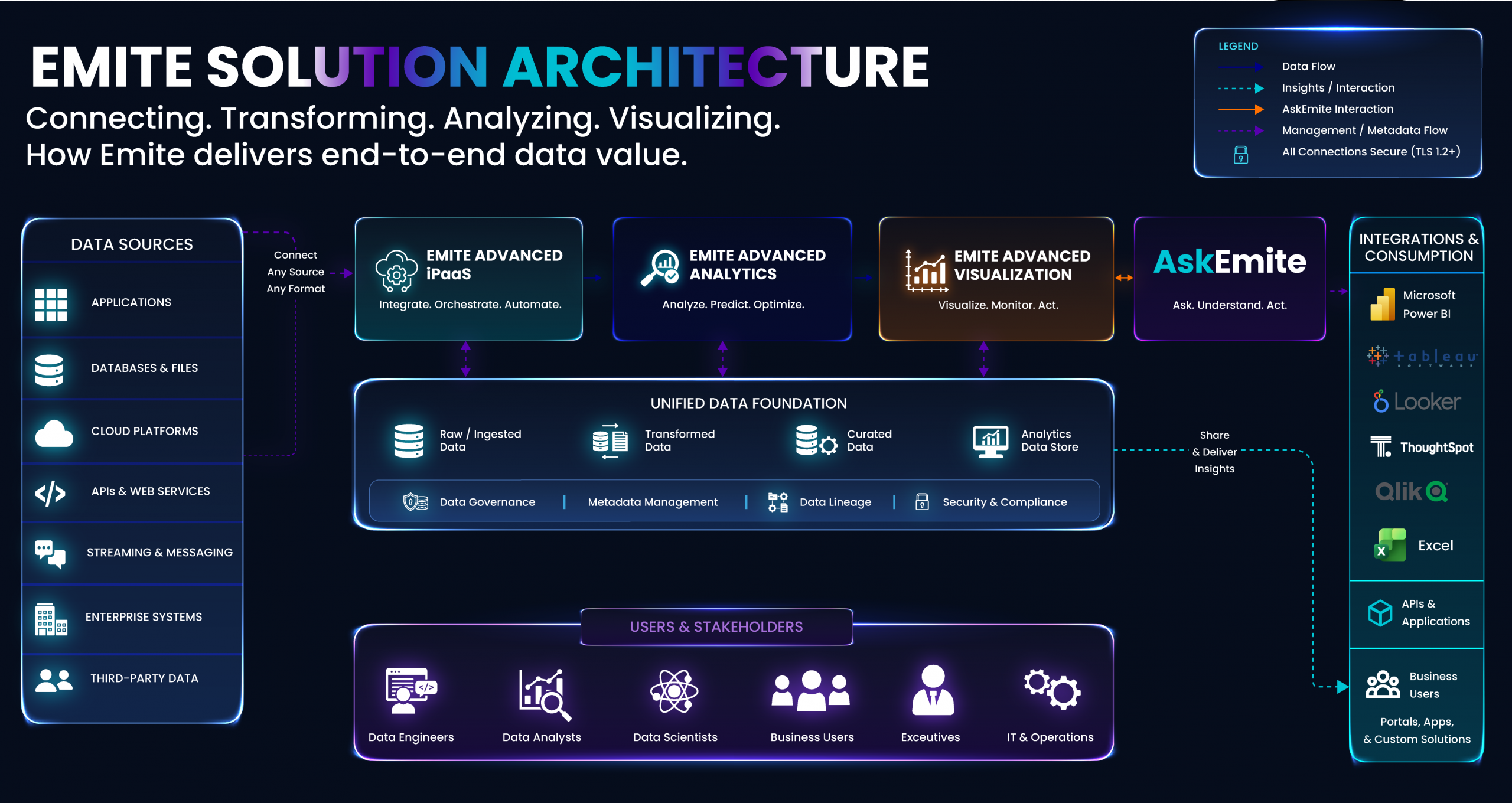
emite Advanced iPaaS (Integration)
- Connects to any S3 or REST API/source and normalizes payloads
- Applies validation, transformation, and deduplication rules
- Orchestrates streaming and scheduled syncs for low latency consistency
emite Advanced Analytics (KPI & Governance)
- No code KPI builder with shared, governed definitions
- Cross source metric computation and audit trails
- Data quality dashboards and anomaly detection to flag inconsistency
emite Advanced Visualisation (Trust at the last mile)
- Role based, embedded dashboards that always reference the governed KPI layer
- Multi language, audience specific views without redefining metrics
- Scheduled reports & alerts to prevent “multiple versions of the truth”
AskEmite
- Ask which records or KPIs look inconsistent, in plain English, instead of hunting through dashboards.
Every answer is explainable and auditable — surfacing not just what’s inconsistent, but why.
Federated architecture means AskEmite queries your governed data in place — no new copies, no new inconsistency risk introduced by the AI layer itself.
Featured Use Cases
Utilities — Asset & incident truth
Challenge: Asset, maintenance, and outage systems disagree on incident counts and durations.
Solution: Streamed integration with schema mapping; dedupe work orders; consistent MTTR/SAIDI/SAIFI definitions in Analytics; role based ops dashboards.
Outcome: Accurate service metrics, faster root cause, fewer customer credits from reporting errors.
Financial Services — Regulatory & revenue reporting
Challenge: Branch and product systems produce different revenue and exposure numbers.
Solution: iPaaS normalizes core banking, CRM, and risk feeds; Analytics enforces single KPI logic; Visualisation delivers governed dashboards to Finance and Risk.
Outcome: One reconciled number for management and regulators; materially reduced audit findings.
What does Reducing Risk from Data Inconsistency look like!
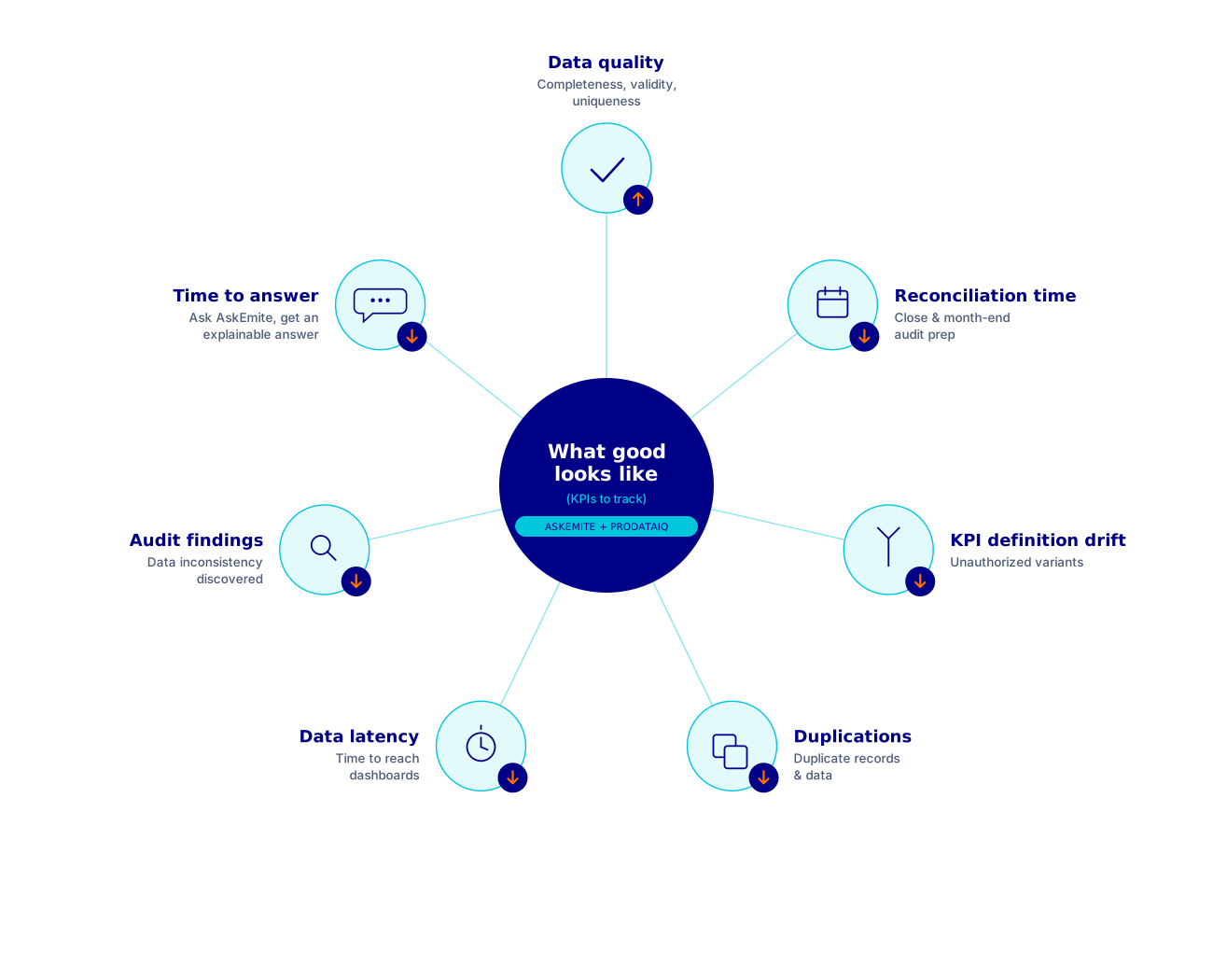
Integration Pattern

1. Discover & profile
Identify inconsistent fields, duplicate entities, and KPI drift

2. Model & Map
Define canonical & dynamic schemas and business definitions.

3. Automate Pipelines
Use Advanced iPaaS to normalize, validate, and transform.

4. Govern KPIs
Centralize definitions and version control in Advanced Analytics.

5. Distribute truth
Regional variances respected while baselining on centralised governed dashboards and reports via Advanced Visualisation.

6. Monitor & Improve
Track DQ scores and anomaly alerts; iterate rules.
Ready to eliminate data inconsistency risk?
Book Your Demo Today and turn your data into decisions that drive measurable results.
FAQ
What causes data inconsistency?
Different schemas, duplicate systems, manual exports, and region specific rules create conflicting values and KPIs. Also endpoint limitations, rate limits) and data availability means matching is full of errors and can create misleading data. emite standardizes schemas and definitions, validates records, and applies one KPI logic across sources.
How does emite prevent “multiple versions of the truth”?
KPI logic is defined once in Advanced Analytics and reused everywhere—dashboards, exports, and alerts—so teams consume the same governed metrics.
Can emite work with any REST API, or S3 source?
Yes. Advanced iPaaS connects to any REST API or S3 and many many more sources. It normalizes payloads with mapping, transformation, validation, and dedupe steps to transform data into a consistent format.
Does this help AI initiatives?
Absolutely. Consistent, validated data reduces model bias and error, improving AI reliability and explainability.
How fast can we see consistent data?
Streaming pipelines minimize lag; most customers see improved alignment as soon as canonical mappings and KPI definitions are applied. Depending on source emite Advanced iPaaS scales to meet any volumes. Currently there are organisations generating more than 120 million events in a day and over 900k records through iPaaS, which equates to a sustained 1.4k EPS and can scale to over 2500 EPS.
Does adding AskEmite introduce new data inconsistency risk?
No. AskEmite reasons across your existing governed emite data in place — it doesn’t create new copies or new sources that could drift out of sync. Federated querying means there’s no additional data to keep consistent.
Can AskEmite help identify where inconsistencies exist?
Yes. You can ask AskEmite directly why two figures don’t match or which source is out of date, and get an explainable answer that traces back to the underlying data — turning a manual reconciliation task into a plain-English question.
Latest Blogs