Newsletter Article
THE GLOBAL DEMAND FOR DATA EXPERTISE
The trends and business impact as we move to an AI Driven world.

Big Data Specialists are among the fastest-growing roles through to 2030
AI and big data are also expected to be the fastest-growing areas of skills demand.[1]
The growth reflects a broader business shift. Organisations increasingly need people who can turn expanding volumes of information into commercial, operational and customer insight.
Together, these forces mean that data science has shifted from a competitive advantage to a baseline operational requirement and the talent demand reflects that.
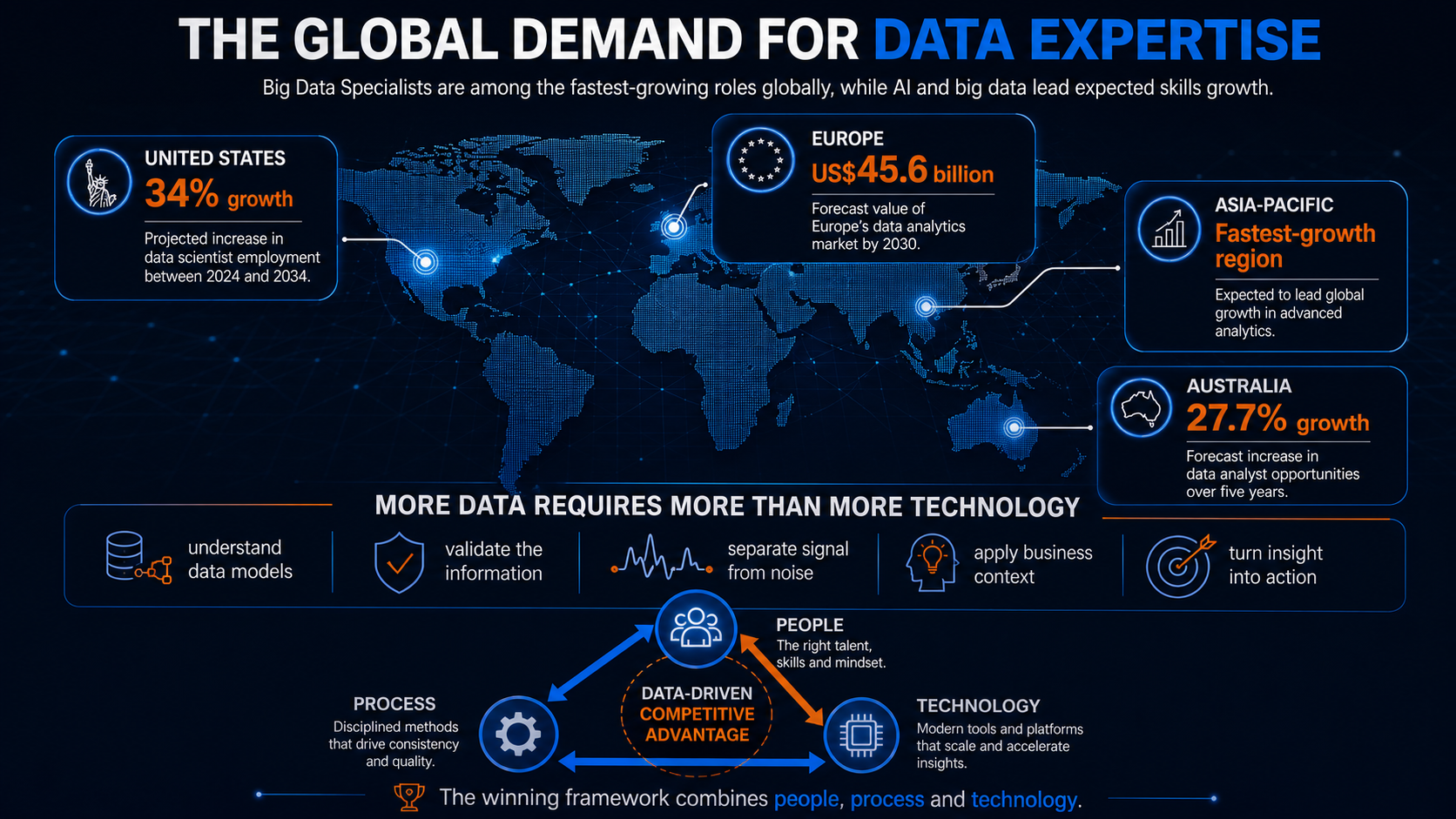
34% projected growth in data scientist employment
The US Bureau of Labor Statistics projects employment for data scientists to grow by 34% between 2024 and 2034.[2]
This demand is being driven by the expanding number of applications across the enterprise technology stack, each generating more data and increasing the need for organisations to turn that information into better decisions. But data volume alone has little value without the expertise to separate meaningful signals from noise. From regulatory risk and operational performance to customer personalisation, organisations need dedicated analytical capability rather than relying on ad hoc reporting.
Data scientists are therefore increasingly required not only to interpret data, but also to build the models, pipelines and infrastructure that allow analytics and AI tools to operate reliably at enterprise scale.
A growing market with a higher governance bar
One industry forecast estimates that Europe’s data analytics sector will grow at a compound annual growth rate of 11.8%, reaching US$45.6 billion by 2030.[6]
AI adoption is also accelerating. In 2025, 20% of EU enterprises with at least ten employees reported using AI technologies, up from 13.5% in 2024.[7]
However, the European market is shaped by more than growth.
Privacy, data governance, transparency and human oversight are becoming integral to how organisations collect, analyse and apply information.
The EU AI Act adds specific data governance obligations for certain high-risk AI systems, alongside Europe’s established data protection environment.[9]
This is increasing the value of professionals who can combine technical capability with:
Europe’s next data challenge is not simply expanding the use of AI.
It is scaling AI in a way that is connected, trusted and explainable.
27.7% projected growth in data analyst opportunities
Demand is expanding as more Australian organisations seek the skills needed to interpret information and translate it into business outcomes.[3]
The growth reflects the same wider challenge being seen globally: organisations are generating more data, but extracting trusted and timely value from it remains difficult.
Skills are changing faster in AI-exposed roles
PwC reports that the skills sought in jobs most exposed to AI are changing 66% faster than those in less-exposed roles.[4]
At the same time, critical thinking, judgement, creativity, leadership and problem-solving are becoming more important, not less.
As AI applications expand and more routine tasks become automated, the need to interpret, validate and apply data will only increase.
Solutions such as AskEmite will enable more people to investigate performance, interrogate results and make faster, better-informed decisions. But the role of the data analyst is not disappearing. Deep analytical expertise, data modelling knowledge and an understanding of business context will remain essential to ensuring that insights are accurate, relevant and actionable.
Competitive advantage will not come from technology alone. It will come from the right combination of people, process and technology—with skilled professionals applying judgement and expertise to the intelligence that connected data and AI can provide.
The fastest-growth region and one of the most diverse
Asia-Pacific is forecast to record the highest regional growth in advanced analytics, driven by the rapid adoption of cloud platforms, automation and intelligent decision-making technologies.[12]
The wider regional AI market is projected to grow from US$102.6 billion in 2025 to approximately US$816 billion by 2032, representing a compound annual growth rate of 34.5%.[13]
However, the region is not moving at one consistent speed.
India is expected to record the highest country growth rate in the Asia-Pacific advanced analytics market.[12]
Its Global Capability Centres are also evolving from cost-focused support functions into strategic hubs responsible for analytics, product development, research and complex commercial processes.
As this work becomes more sophisticated, demand for specialised AI, data and machine-learning expertise is outstripping supply.
The value of the Indian market is increasingly based not only on the scale of its workforce, but on its ability to deliver higher-value analysis and business outcomes.[15]
Southeast Asia’s digital economy generated approximately US$300 billion in gross merchandise value during 2025, maintaining year-over-year growth of 15%.[14]
Growth across digital commerce, financial services, online platforms and cloud-based operations is creating significantly more customer and operational data.
For organisations across Indonesia, Malaysia, the Philippines, Singapore, Thailand and Vietnam, the opportunity is substantial.
But capturing it depends on being able to connect information across expanding digital ecosystems and convert it into meaningful business insight.
South Korea’s adoption of AI is increasing the importance of high-level skills, including data analysis, interpretation and communication.[16]
Japan faces a different challenge.
Labour and skills shortages are creating a strong case for AI-supported productivity, but workplace adoption remains comparatively low. This creates both a significant opportunity and an urgent need for people who can combine data, technology and operational experience.[17]
Across Asia-Pacific, the common requirement is not simply more technical talent.
It is talent that can connect technical capability with business context, commercial decisions and responsible implementation.


 THE DATA TALENT BOOM IS ALSO A COMPLEXITY WARNING