Newsletter Article
THE DATA TALENT BOOM IS ALSO A COMPLEXITY WARNING
The average organisation now manages almost 1,000 applications. The challenge is no longer collecting data—it is making those systems produce a coherent view of the business.

The modern enterprise did not set out to build a technology stack containing almost 1,000 applications.
It accumulated one.
A new CRM was introduced to improve sales visibility. A contact centre platform transformed customer interactions. A workforce solution improved scheduling. Finance adopted specialist planning software. Marketing added automation, analytics and customer data tools. Individual business units selected applications designed for their own operational requirements.
Each decision may have solved a legitimate problem.
Collectively, however, those decisions created an increasingly complex data environment.
According to Salesforce’s 2026 Connectivity Benchmark Report, the average organisation now manages approximately 957 applications, up from 897 a year earlier. Yet only 27% of those applications are connected.[1]
This is the real data complexity gap.
Organisations have invested in more technology, created more data and introduced more analytical capability. But the information needed to understand the business remains distributed across hundreds of systems, each with its own definitions, structures, permissions and operating logic.
The result is an environment in which acquiring data has become easier, while producing a complete and trusted business answer has become harder.
It is tempting to think that one additional application creates one additional data source.
In practice, every application introduces several new dimensions of complexity.
It may have its own:
It must also interact with parts of the existing environment.
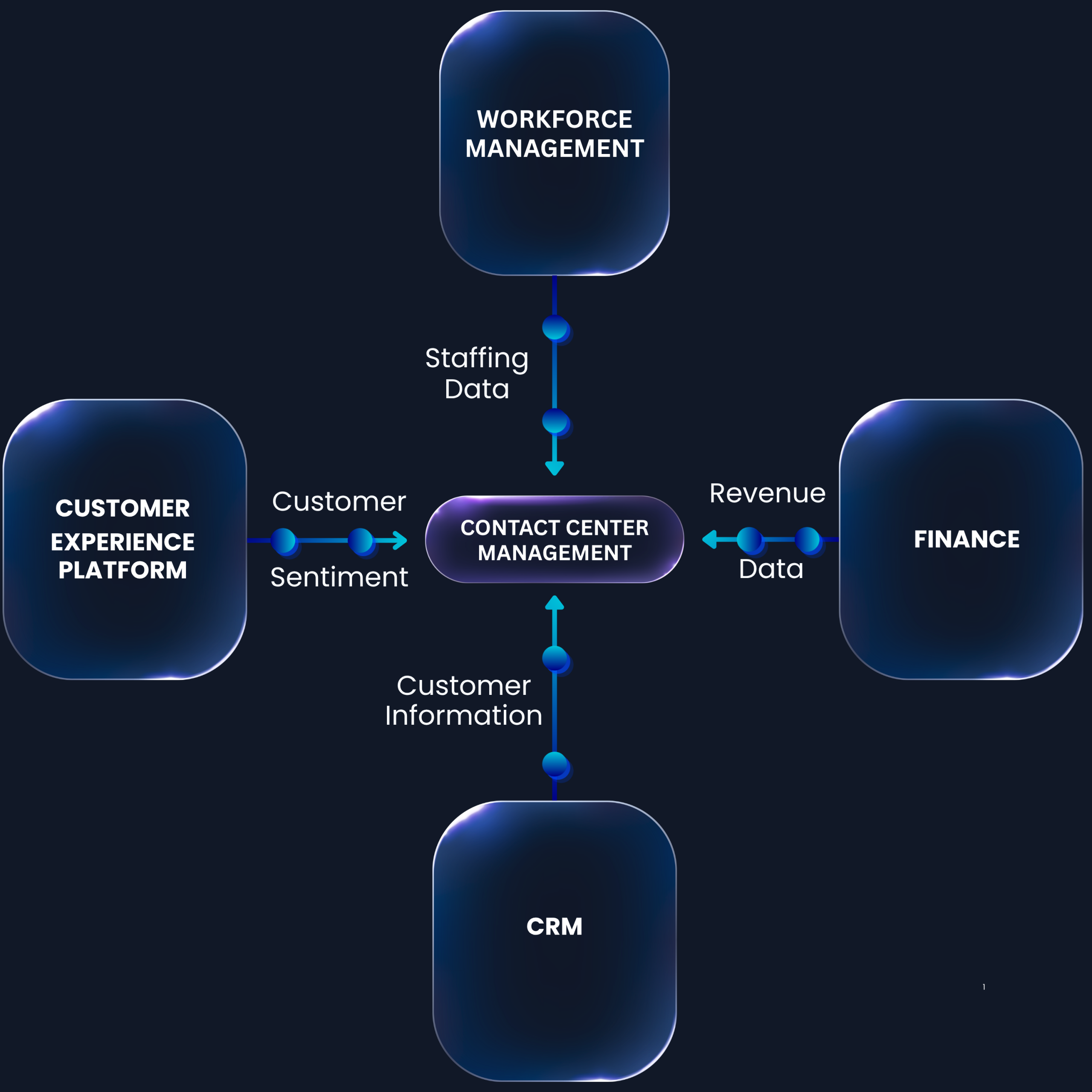
A contact centre application may need customer information from the CRM, staffing data from workforce management, revenue data from finance and sentiment data from a customer experience platform.
The complexity therefore does not come only from the number of applications. It comes from the growing number of relationships between them.
If every system in a 957-application portfolio needed to connect directly with every other system, there would be more than 457,000 potential pairwise relationships.
No organisation needs every possible connection. But the calculation illustrates an important point: integration complexity compounds as the technology estate expands.
Every new system can introduce another set of dependencies, transformations and decisions about how data should move through the organisation.
The growth of enterprise software has delivered genuine value.
Specialist applications allow individual functions to select technology closely aligned with their needs. Cloud delivery has made new tools easier to acquire and deploy. Business units no longer need to wait for lengthy central development programs before solving an immediate operational problem.
But local optimisation can create enterprise fragmentation.
Each team may gain a better application while the organisation loses a consistent view of performance.
Sales sees the customer through the CRM.
The contact centre sees the customer through interactions, queues and service levels.
Marketing sees campaigns, engagement and conversion.
Finance sees revenue, cost and account structures.
Workforce; teams see schedules, capacity and productivity.
Each view may be accurate within its own system. None necessarily represents the complete relationship between customer activity, employee performance, operational conditions and commercial outcomes.
This is why important business questions frequently become difficult to answer.
A decline in customer satisfaction may be visible in one platform, but the underlying cause could sit across several:
No single application holds the full explanation.

Data silos are often discussed as though they are simply technical barriers preventing systems from exchanging information.
The impact is broader.
When information remains fragmented, teams may work with incomplete, duplicated, outdated or inconsistent data. Different workflows can emerge around the same customer, process or business event. Reporting logic is recreated across departments, and several apparently authoritative versions of the same measure begin to circulate.[2]
This creates multiple forms of complexity.
Structural complexity
Different systems organise information differently.
One may record individual interactions. Another may aggregate activity by customer. A third may store performance by employee, team or reporting period.
Bringing these datasets together requires more than matching column names. The organisation must understand the level of detail represented by each record and how those records relate.
Semantic complexity
Two systems may use the same term while measuring different things.
“Customer,” “contact,” “resolution,” “conversion” and “service level” can all have multiple valid definitions.
One dashboard may count all interactions. Another may exclude abandoned contacts. A third may measure only interactions associated with a specific queue, channel or outcome.
The numbers may all be technically correct while still producing conflicting interpretations.
Identity complexity
The same customer may appear under different identifiers across CRM, billing, contact centre and digital platforms.
An employee may be represented by a payroll number, network identity, platform username or email address.
Without consistent identity resolution, analysts must determine whether records from separate systems refer to the same person, account or event.
Time complexity
Systems update at different speeds.
One platform may stream events in real time. Another may refresh hourly. Finance data may close daily or monthly. Customer feedback may arrive several days after an interaction.
Combining these sources without understanding their timing can create misleading comparisons or apparently contradictory results.
Governance complexity
Each application has its own access model, data ownership, retention policy and security controls.
As data is extracted and copied into spreadsheets, local databases and reporting tools, the organisation can lose visibility over who has access, which version is current and how the information has been transformed.
Operational complexity
Applications change.
Vendors update APIs. Fields are renamed. Business processes evolve. New products and channels are introduced. Acquisitions add another technology environment.
An integration that worked yesterday may still run tomorrow while silently delivering incomplete or incorrectly interpreted data.
When technology does not connect information effectively, the work does not disappear.
It moves to the analyst.
Analysts are asked to locate the relevant datasets, request access, export files, reconcile formats and create joins between systems that were never designed to work together.
They may need to determine:
In effect, analysts become human middleware.
Their expertise is used to compensate for gaps in integration, metadata, governance and data modelling.
This has several consequences.
Analysis takes longer because every question begins with data preparation.
Reports become difficult to reproduce because logic is stored in individual spreadsheets, scripts or analyst knowledge.
Business continuity becomes dependent on the people who understand how the systems fit together.
And skilled professionals spend less time interpreting performance because they are occupied assembling the evidence.
Hiring another analyst can increase the organisation’s ability to perform this manual work.
It does not remove the reason the work exists.
Organisations often respond to growing information needs by creating more dashboards.
A dashboard is developed for customer service.
Another monitors workforce performance.
A third reports financial outcomes.
Business units build local dashboards to answer their own questions, while executives receive consolidated reports created through a separate process.
This can create the appearance of a data-rich organisation.
But more dashboards do not necessarily mean greater clarity.
Each dashboard may contain:
Over time, dashboard proliferation can reproduce the same fragmentation that already exists across the application portfolio.
The presentation becomes more sophisticated, but the underlying information remains disconnected.
This is why organisations can have extensive reporting capability and still spend significant time debating which number is correct.
The problem is not necessarily a lack of visualisation.
It is the absence of a consistent data and semantic foundation beneath it.
The cost of a fragmented technology stack is not limited to IT maintenance or analyst productivity.
It affects how quickly the organisation can recognise and respond to change.
Consider a sudden decline in customer satisfaction.
If the relevant information is spread across contact centre, workforce, CRM, survey and financial systems, the organisation may need several teams to gather data before it can understand the cause.
By the time the analysis is complete:
This delay is a form of decision latency: the time between something changing in the business and the organisation understanding it well enough to respond.
Technology is often introduced to increase speed.
But when each platform creates another isolated view, the combined environment can slow the decisions it was intended to improve.
Data does not create value merely because it is available.
People must trust it enough to act.
That trust erodes when:
Once confidence declines, teams create their own validation processes.
They maintain local spreadsheets, perform additional checks and ask analysts to confirm results before making decisions.
These actions are rational responses to uncertainty.
They also add more duplication, delay and complexity.
The organisation enters a cycle in which fragmented data creates low trust, and low trust creates more local data handling.
Closing the data complexity gap does not mean creating a direct connection between every application.
Nor does it necessarily require moving all data into one enormous central repository.
The goal is to create a governed and reusable way to connect the information required for important business decisions.
That begins with business questions.
Which customer outcomes matter most?
Which operational changes require faster visibility?
Where are leaders currently making decisions with incomplete information?
Which reports create the most disagreement?
Which analytical processes depend on manual extraction?
Which AI use cases require context from several systems?
These questions help identify the information relationships that matter most.
From there, organisations can build a data foundation around priority outcomes rather than attempting to integrate the entire technology estate without a clear purpose.

Organisations need to know which systems they operate, what information those systems hold and where important data is duplicated.
This includes understanding unofficial tools and local processes that may sit outside the centrally managed portfolio.
Without visibility, organisations cannot distinguish between necessary specialist technology and avoidable duplication.
Point-to-point connections solve individual requirements but can create a tangled network of dependencies as their number increases.
Reusable integration services, APIs and event-driven approaches allow information to be made available across multiple use cases without rebuilding every connection from the beginning.
The aim is to reduce repeated engineering while maintaining control over how information moves.
A connected architecture must also address meaning.
Organisations need governed definitions for critical entities and metrics, including customers, interactions, employees, products, resolutions and performance measures.
This semantic layer ensures that users and systems are not simply accessing the same data, but interpreting it consistently.
Teams need to know where information originated, how it was transformed and whether it is appropriate for the intended use.
Metadata and lineage make analytical outputs easier to understand, reproduce and govern.
They are also essential when data is used to support AI-generated answers.
Not every decision requires real-time information.
But organisations need the ability to combine current events with historical patterns where the use case demands it.
A current decline in service level becomes more meaningful when viewed alongside staffing, customer demand and previous performance.
The architecture must support the timing requirements of the decision—not simply the refresh cycle of an individual application.
Business users should be able to explore authorised information without requiring a new manual report for every question.
But self-service should operate on governed data and consistent definitions.
Otherwise, the organisation simply transfers fragmentation from the data team to the business user.
Enterprise technology will continue to expand.
New applications, data sources and AI agents will be introduced because they can solve genuine business problems.
The answer is not to stop adopting technology.
It is to prevent every new capability from becoming another isolated source of information and another manual task for the data team.
Organisations need an architecture that connects important data, preserves business meaning and makes context reusable across analytics, operations and AI.
Without that foundation, more applications create more data, more dashboards and more analytical work, but not necessarily better understanding.
Hiring more analysts may help an organisation manage the resulting complexity.
Connecting the technology estate helps reduce it.
That is the difference between expanding the data function and building a business that can use its data effectively
See how emite, ProDataIQ and AskEmite can help your organisation connect fragmented information, reduce repetitive data preparation and create a clearer path from business question to action.


 PEOPLE, PROCESS AND TECHNOLOGY: A CONTINUOUS GOVERNANCE SYSTEM