The Data Advantage #12, October 2026

Newsletter: Issue #12

THE INTERVENTION ADVANTAGE

Intelligence that arrives in time to change the outcome

AI can identify what is happening. The bigger opportunity is recognising what matters, understanding the impact, and recommending the right intervention while there is still time to make a difference.

Welcome to the Data Advantage: Issue #12,

There is a moment in almost every operation when an emerging problem is still an opportunity.

A service queue is starting to stretch, but customers are not yet abandoning their calls. A patient referral is approaching its contact deadline, but the scheduling team still has capacity to respond. A disruption is about to generate hundreds of enquiries, but there is still time to communicate proactively.

These are the moments when intelligence has its greatest operational value.

Over recent issues we have built a connected argument: from data to context (Issue #10), and from context to orchestrated action (Issue #11). In October we take the next practical step: how do we turn that intelligence into meaningful interventions?

That takes more than anomaly detection. It means understanding the operational significance of a signal, evaluating what is likely to happen next, establishing which responses are available, and delivering a relevant recommendation to the person who can make the difference.

This month we look at how organisations can engineer that decision process — intelligent alerting, contextual recommendations and outcome measurement — and take a detailed look at healthcare patient access, where connecting customer experience, workforce and operational data makes a tangible difference. As always, the evidence comes from analyst and peer-reviewed research rather than a vendor pitch.

The principle applies to every industry:

The value of intelligence increases when it arrives with enough context, clarity and time to act.

AT A GLANCE

50%

of business decisions will be augmented or automated by AI agents for decision intelligence by 2027. (Gartner)

54x

increase in data-reviewer efficiency from a deployed, AI-ranked public-health monitoring system, compared with traditional alert-based methods. (AAAI, 2026)

77%

of customer service and support leaders feel pressure from other senior executives to deploy AI. (Gartner, 2025)

Three different findings, one direction: decisions are becoming the unit of AI value, prioritisation makes intelligence more usable, and the pressure to deploy AI makes measurable outcomes essential.

TL:DR

Quick Read

1. THE DECISION WINDOW: WHEN INTELLIGENCE HAS THE GREATEST VALUE

The most valuable operational insight is the one that still has time to change what happens next.

Operational intelligence has traditionally been about visibility: what happened, what changed, and how performance compares with expectations. AI extends that value forward, making intelligence useful earlier in the life of an operational event.

Consider a contact centre on a busy Monday morning.

At 10:00 a.m., inbound volume is slightly above forecast. By 10:15 a.m., higher demand, longer handling times and fewer available agents together suggest service performance is about to deteriorate. By 10:45 a.m., customers are already waiting longer.

Each moment supports a different kind of intelligence. A historical report explains what happened. A real-time dashboard shows what is happening. An intelligent intervention adds a third layer: what is likely to happen next, and which actions are still available.

That third layer matters because operational decisions have a time dimension. A recommendation to redistribute capacity is valuable at 10:15 a.m., before a service-level target is missed. The same recommendation at 11:15 a.m. becomes a post-incident observation.

Forrester captures the broader direction in its March 2026 analysis of customer service platforms: service is shifting from “a reactive, cost-heavy, and manual function” to “a proactive function that drives revenue growth.” Gartner, meanwhile, predicts that by 2027, 50% of business decisions will be augmented or automated by AI agents for decision intelligence.

Proactive operations rest on a straightforward discipline: designing intelligence around the decisions it is meant to improve. That gives every operational team a practical test for any insight:

What decision could this insight improve — and how much time remains to make it?

DEFINITION
The Decision Window is the period between identifying a meaningful emerging risk and the point at which an intervention can no longer materially improve the outcome.

The window varies by operation: minutes in a contact centre, hours in field service or retail fulfilment, days in a healthcare scheduling process. The design principle stays constant. Intelligence earns its value when it reaches the right person inside that window, with enough context to act.

This also gives AI a focused, achievable brief. Forecasting every operational movement is neither realistic nor necessary. Recognising the specific conditions that deserve attention, early enough for an effective response, is where the value sits — and it is the thread that runs through the rest of this issue

2. WHY THE NEXT GENERATION OF ALERTS MUST BE MORE INTELLIGENT

From detecting deviations to identifying the decisions that deserve attention.

Fixed thresholds remain the right tool for clear, deterministic limits. Operational importance, though, usually depends on more than one number: whether a movement is unusual for this time and context, which outcomes it affects, whether it is persisting, how quickly it could escalate, and whether a practical intervention exists.

Intelligent alerting brings those dimensions together, so the alerts a team receives are the ones most worth its attention.

RESEARCH SPOTLIGHT: AI AND ALERT FATIGUE

A ranking-based AI anomaly-detection system deployed at a national public health organisation — analysing up to five million data points a day — delivered a 54-fold increase in data-reviewer efficiency over a three-month evaluation, compared with traditional alert-based methods. Human reviewers retained verification of important findings.

Joshi et al., Proceedings of the AAAI Conference on Artificial Intelligence, 2026. A public-health deployment rather than a contact centre study; the transferable lesson is prioritisation.

The full article sets out the five dimensions of intelligent alerting (expected behaviour, business impact, persistence, urgency and actionability), shows four retail fulfilment notifications becoming one alert, and includes a two-week audit for sorting the alerts you already send into interrupt, merge, inform, automate or retire.

3. INDUSTRY SPOTLIGHT: HEALTHCARE

The Patient Access Challenge

When the contact centre is one part of a larger patient journey.

A patient calls to arrange an appointment. The conversation starts in the contact centre, but whether that patient is seen on time depends on referral status, clinician availability, appointment capacity, eligibility rules, workforce and communication history, each held in a different system.

It is a challenge patients feel directly. Experian Health’s 2026 State of Patient Access survey found that obtaining timely appointments was the most commonly reported patient challenge for the fourth consecutive year.

Patient access is where the ideas in this issue come together. Access targets are protected or missed in a decision window of hours, and the signals that reveal emerging risk sit across several systems. Our infographic shows the difference that context makes: a threshold alert reports a backlog, while a decision-ready alert explains what is at risk, who should act, how long remains and which permitted options are available.

The full use case follows a patient access team through a morning shift: how the alert is assembled from six data sources, what each role on the team needs to see, the clinical and privacy guardrails that apply, and the outcome measures that show whether an intervention worked.

Feature Article

4. ANATOMY OF AN ALERT WORTH ACTING ON

A useful alert is a decision-ready briefing.

One of the most practical ways to improve operational intelligence is to redesign what people see when something significant happens. Start with the decision the recipient needs to make, then build the alert around it. A decision-ready alert answers seven questions:

Question What the alert provides
1 What has changed? The operational event and the evidence behind it
2 Why does it matter? The business outcome at stake, beyond the technical metric
3 What is contributing? Related signals, with verified facts separated from possible explanations
4 How much time is available? When action is most useful, and when escalation is due
5 What can be done? Practical, permitted options and their constraints
6 Who should respond? The role with responsibility and authority to act
7 How will we know it worked? What should improve, when to measure, what triggers reassessment

The full article builds one alert line by line, shows how the same briefing adapts to a mobile notification, a team chat card and a dashboard, and includes a phrasebook for writing alerts people can act on.

The most valuable alert is the one that helps prevent the most meaningful avoidable outcome.

The seven tests also feature in the Decision-Ready Alert Canvas available for free in the full article

5. FROM AI INSIGHT TO MEANINGFUL RECOMMENDATIONS

The next best action needs to be relevant, feasible and appropriate.

A generic recommendation says “increase staffing.” A useful one checks whether appropriately skilled staff are available, whether moving them compromises another service, and how long the adjustment remains beneficial. It is also clear about what is verified and what is still a likely contributor.

Three principles shape better recommendations:

  • Evidence before explanation: communicate what is known, and what warrants further investigation.
  • Options before automation: routine, low-risk actions may be automated where authorised; consequential decisions follow defined approval paths.
  • Business relevance before technical sophistication: a modest, persistent change to a critical service can matter more than a statistically dramatic anomaly.

Gartner identifies agent enablement — including real-time customer data insights and next-best-action recommendations — as one of the four areas where AI delivers the most value in customer service and support. The full article looks at how to connect those capabilities to real operational decisions, and why a frontline team leader, an operations manager and a service executive each need a different recommendation from the same emerging condition.

That is persona-based intelligence in practice: different decision responsibilities, each served with the information and authority that role requires.

An extended guide to decision contracts, prioritisation models and outcome measurement for data and operations teams

TECHNICAL DEEP DIVE

6.ENGINEERING DECISION-READY INTELLIGENCE

From event correlation to governed intervention and outcome feedback.

Meaningful AI alerting is a data-engineering, decision-design and governance discipline as much as a modelling one. The system has to correlate events reliably, establish appropriate baselines, estimate operational impact, identify permitted responses, and track what happens after a recommendation is delivered. The deep dive works through six layers:

Layer What it involves
6.1 Establish the decision contract Define the objective, owner, observation window, evidence, detection condition, options, guardrails, deadline and outcome measure before writing detection logic
6.2 Correlate events across sources Event-time alignment, identity resolution, late or duplicated events, version-controlled KPI definitions, provenance and freshness
6.3 Detect against meaningful baselines Contextual baselines by time, season, unit and service type; event grouping, deduplication and suppression
6.4 Prioritise by operational value Likelihood, severity, time remaining, feasibility of action and reliability of evidence
6.5 Recommend within policy boundaries Observed facts, likely contributors, permitted interventions and approval requirements, kept distinct
6.6 Close the feedback loop Acknowledgement, acceptance, action taken, whether the condition occurred and whether the outcome improved

The article draws on Google’s Site Reliability Engineering guidance — alerts should be timely, tied to user impact and actionable — and the NIST AI Risk Management Framework for governance, measurement and production monitoring.

Prediction quality and intervention effectiveness are separate questions, and both deserve measurement.

Quick Read

7. MEASURING THE OUTCOME, NOT JUST THE ALERT

Better AI measurement starts with what changed in the business.

Technical measures — whether a report was available, a dashboard refreshed, or an alert fired when a rule was met — confirm the system is working. Decision measures confirm it is useful. An intelligent alerting programme needs both.

Measure What it tells the organisation
Actionable alert rate How often an alert warrants a practical response
Time to acknowledgement How quickly the responsible person engages
Time to intervention How long it takes to implement a response
Recommendation acceptance Whether proposed actions are useful in practice
False-alert burden How much unnecessary attention the system consumes
Business outcome Whether the targeted operational measure improves
Policy compliance Whether interventions stay within approved boundaries

In the healthcare example, outcome measures could include time to initial patient contact, referral backlog age, appointment-creation time and patient communication experience. In a contact centre, they might include service-level adherence, avoidable repeat contacts, abandonment and speed of service recovery.

Attribution matters. An improvement after an alert does not automatically prove the alert caused it. Where practical, controlled rollouts, comparison groups or matched historical baselines help separate the effect of the intervention from normal operational variation. That makes measurement part of the design from day one.

The measure that matters most is whether the recommendation helped the organisation make a better decision

DOWNLOADABLE ASSET

8. PRACTICAL FRAMEWORK: DESIGN YOUR NEXT INTELLIGENT INTERVENTION

A decision-first exercise for data, analytics and operations leaders.

Start with one operational decision that occurs frequently and has a measurable impact, then select the technique. These eight questions turn that decision into an intelligent-alerting opportunity:

Design question What to establish
1. Which outcome matters? The service, customer or business measure to protect or improve
2. What is the decision window? When intervention would be most valuable
3. What signals are available? The operational evidence required
4. What context is missing? Related systems, constraints and historical baselines
5. Who owns the decision? The role with responsibility and authority
6. Which actions are permissible? Available options, dependencies and approvals
7. What should the alert communicate? Business impact, evidence, urgency and proposed response
8. How will success be tested? Decision quality, intervention adoption and business outcomes

Define how the current process identifies the condition, establish the additional information needed to evaluate it, and design the recommendation around the person who will act. Then test it with operational users, data specialists and governance stakeholders. It is a practical way to prove value with one decision before scaling to more.

THE QUESTION TO TAKE BACK TO YOUR TEAM

If your organisation could recognise one emerging operational problem 30 minutes earlier, with enough context to recommend a useful intervention, which problem would you choose?

The answer is often the strongest starting point for an AI use case with measurable value

Download the playbook: Design Your Next Intelligent Intervention. Eight practical plays take your team from one operational outcome to a tested, decision-ready intervention, with a worked healthcare patient-access example, a worksheet for your next workshop, a 30-day pilot plan and a quick quiz to benchmark how decision-ready your operation is today.

emite Perspective

9. WHERE EMITE FITS INTO THE NEXT ERA OF OPERATIONAL INTELLIGENCE

From connected information to intelligence that supports decisions.

The developments in this issue point to an expanded role for enterprise analytics: connecting information across systems, interpreting changing conditions in business context, and putting relevant insight in front of the people responsible for performance.

That is the direction emite continues to evolve in.

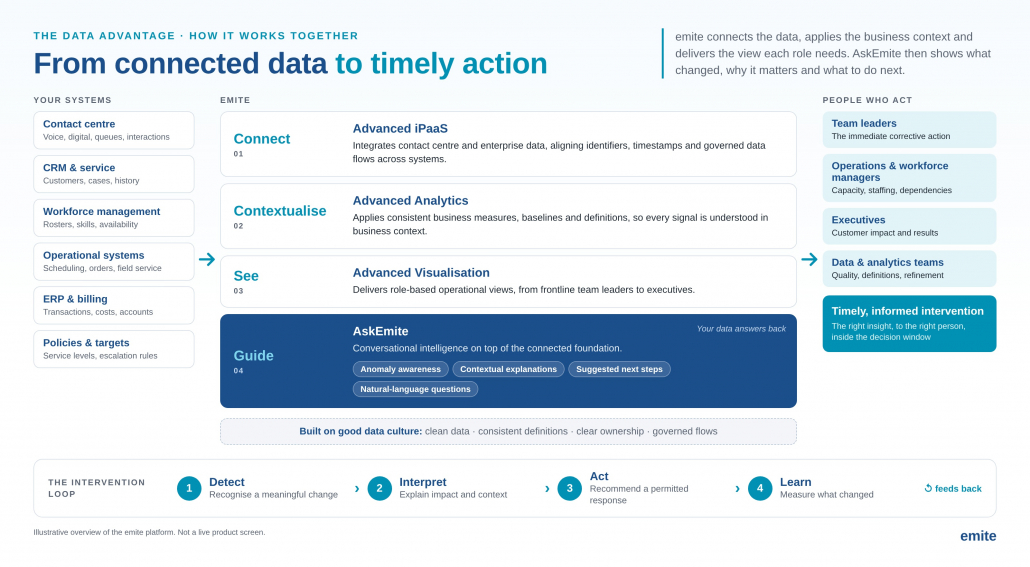
emite brings contact centre and enterprise data together through Advanced iPaaS, applies consistent business measures through Advanced Analytics, and delivers operational visibility through Advanced Visualisation.

AskEmite builds on that foundation — your data answers back — with natural-language interrogation, anomaly awareness, contextual explanations and suggested next steps. Together, they shorten the distance between recognising an emerging condition and understanding what to do about it.

As we prepare to share the next evolution of emite, our focus remains on helping organisations get more from the data they already have: insight that is more accessible, more relevant and ready at the moments that matter.

Discover what’s next for emite

Join us for our upcoming product update and see how the latest evolution of emite brings connected data, analytics and AI-powered intelligence closer to everyday operational decisions.

10.THE KEY TAKEAWAY

Operational intelligence is moving beyond more information, more alerts and more AI, towards better-timed and better-informed decisions.

That requires intelligence that recognises a meaningful condition, understands its business impact, identifies what can be done and reaches the right person while there is still time.

The evidence is encouraging. AI-supported prioritisation is making human review dramatically more efficient, and analysts expect AI to augment or automate a growing share of business decisions. The opportunity now is to bring those disciplines together.

  • An intelligent alert explains why something matters.
  • A meaningful recommendation reflects what the organisation can actually do.
  • A successful intervention is measured by the outcome it helps deliver.

Detect  →  Interpret  →  Act  →  Learn

The Data Advantage has always been about knowing more.

Now it is also about knowing what matters while there is still time to make a difference. That is the intervention advantage.

See the Intervention Advantage in Action

Discover how emite turns operational signals into meaningful action — connected data, business context and AI-powered intelligence, delivered to the people who act on it.

11. SOURCES AND FURTHER READIN

  1. Gartner, Gartner Announces the Top Data & Analytics Predictions, 17 June 2025. Read the source
  2. Forrester, Think About The Agentic Shift With Your Next Customer Service Solution, Kate Leggett, March 2026. Read the source
  3. Joshi, A., Gormley, N., Gadgil, R., Vajiac, C., Townes, T., Rosenfeld, R. and Wilder, B., Reducing Alert Fatigue Through AI Ranking: A Deployed Public Health Data Monitoring System, Proceedings of the AAAI Conference on Artificial Intelligence, Vol. 40 (IAAI track), March 2026. Read the source
  4. Experian Health, The State of Patient Access 2026, 24 March 2026 (vendor research). Read the source
  5. Gartner, Gartner Says the Most Valuable AI Use Cases for Customer Service and Support Fall into Four Areas, 8 October 2025. Read the source
  6. Google, Site Reliability Engineering: Incident Management Guide. Read the source
  7. NIST, Artificial Intelligence Risk Management Framework. Read the source

Figures are current at the time of writing. Scenarios and figures marked illustrative are examples, not customer results or live product screens. This newsletter is not sponsored or endorsed by any organisation mentioned, and it does not constitute legal, clinical or regulatory advice.

emite
Privacy Overview

This website uses cookies so that we can provide you with the best user experience possible. Cookie information is stored in your browser and performs functions such as recognising you when you return to our website and helping our team to understand which sections of the website you find most interesting and useful.