Newsletter: Issue #12
THE INTERVENTION ADVANTAGE
Intelligence that arrives in time to change the outcome
AI can identify what is happening. The bigger opportunity is recognising what matters, understanding the impact, and recommending the right intervention while there is still time to make a difference.
Welcome to the Data Advantage: Issue #12,
There is a moment in almost every operation when an emerging problem is still an opportunity.
A service queue is starting to stretch, but customers are not yet abandoning their calls. A patient referral is approaching its contact deadline, but the scheduling team still has capacity to respond. A disruption is about to generate hundreds of enquiries, but there is still time to communicate proactively.
These are the moments when intelligence has its greatest operational value.
Over recent issues we have built a connected argument: from data to context (Issue #10), and from context to orchestrated action (Issue #11). In October we take the next practical step: how do we turn that intelligence into meaningful interventions?
That takes more than anomaly detection. It means understanding the operational significance of a signal, evaluating what is likely to happen next, establishing which responses are available, and delivering a relevant recommendation to the person who can make the difference.
This month we look at how organisations can engineer that decision process — intelligent alerting, contextual recommendations and outcome measurement — and take a detailed look at healthcare patient access, where connecting customer experience, workforce and operational data makes a tangible difference. As always, the evidence comes from analyst and peer-reviewed research rather than a vendor pitch.
The principle applies to every industry:
The value of intelligence increases when it arrives with enough context, clarity and time to act.
AT A GLANCE
|
50% of business decisions will be augmented or automated by AI agents for decision intelligence by 2027. (Gartner) |
54x increase in data-reviewer efficiency from a deployed, AI-ranked public-health monitoring system, compared with traditional alert-based methods. (AAAI, 2026) |
77% of customer service and support leaders feel pressure from other senior executives to deploy AI. (Gartner, 2025) |
Three different findings, one direction: decisions are becoming the unit of AI value, prioritisation makes intelligence more usable, and the pressure to deploy AI makes measurable outcomes essential.

In this Issue:
- The Decision Window: When Intelligence Has the Greatest Value
- Why the Next Generation of Alerts Must Be More Intelligent
- Industry Spotlight: Healthcare and the Patient Access Challenge
- Anatomy of an Alert Worth Acting On
- From AI Insight to Meaningful Recommendations
- Technical Deep Dive: Engineering Decision-Ready Intelligence
- Measuring the Outcome, Not Just the Alert
- (Downloadable Asset) Practical Framework: Design Your Next Intelligent Intervention
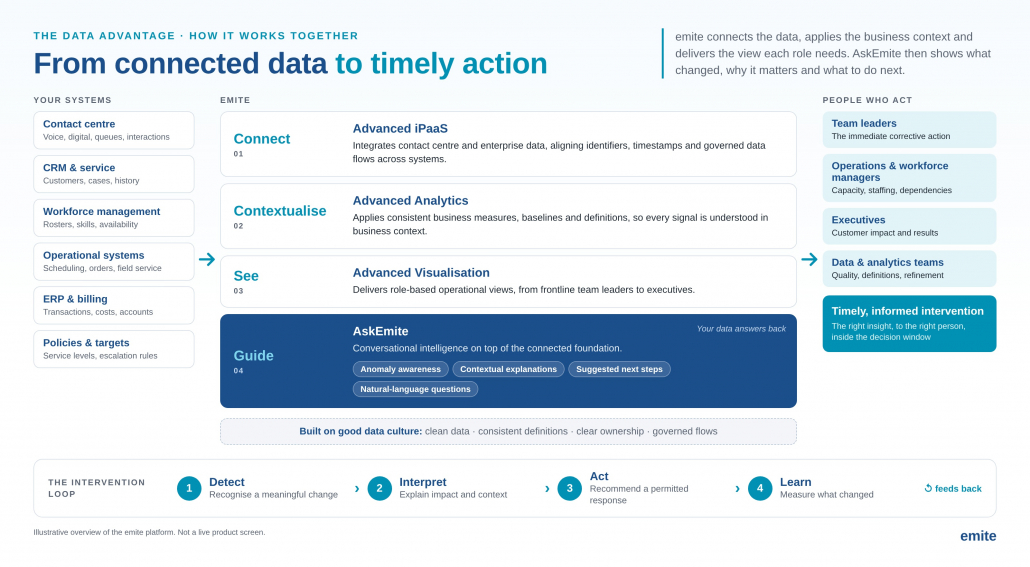
- Where emite Fits into the Next Era of Operational Intelligence
- The Key Takeaway
- Sources and Further Reading