
INDUSTRY USE CASE · HEALTHCARE
How connected data helps patient access teams see emerging risk early, understand what it means and act while there is still time to protect the patient experience.

USE CASE AT A GLANCE
| Operational goal | Protect patient access targets, such as initial contact within a set number of hours and timely referral-to-appointment conversion. |
| The challenge | The signals that reveal emerging risk sit across the contact centre, referral, scheduling, workforce and communication systems. |
| Data brought together | Inbound demand, referral age and status, appointment availability, staff capacity and skills, contact attempts, service policies. |
| Decision window | Typically hours: enough time to rebalance capacity or prioritise contacts if the risk is recognised early. |
| Who it serves | Scheduling team leaders, patient access managers, contact centre and workforce managers, operations executives, data teams. |
| Outcome focus | Time to first contact, contact-target compliance, referral backlog age, referral-to-appointment time, patient communication experience. |
A patient calls to arrange an appointment after a referral from their GP. To the patient, it is a single interaction. To the healthcare provider, it is a chain of dependencies: the referral must be received and triaged, eligibility confirmed, clinician availability matched, an appointment offered and booked, and the patient kept informed at each step.
The conversation starts in the contact centre. Whether that patient is seen on time depends on everything around it.
This makes patient access one of the clearest examples of why operational intelligence needs to extend beyond any single application. It is also a challenge patients feel directly: Experian Health’s 2026 State of Patient Access survey of more than 1,000 patients and 200 healthcare decision-makers found that obtaining timely appointments was the most commonly reported patient challenge for the fourth consecutive year.
This use case shows how a patient access team can bring its data together, recognise emerging risk inside the decision window, and turn that recognition into a timely, accountable intervention.
Patient access is a connected-data challenge
Most patient access teams are well served by their individual systems. The contact centre platform reports on demand and response times. The referral management system tracks referral age and status. The scheduling system holds availability across clinics and locations. Workforce management knows who is rostered and what they are trained to do. Communication platforms record contact attempts and responses.
Each system answers its own questions well. Access targets, though, are shaped by the relationships between them:
- A rise in referral intake matters most when scheduling capacity is constrained.
- A growing backlog matters most when referrals are approaching their contact deadline.
- Spare appointment capacity at another location only helps if schedulers can see it and are permitted to use it.
- Contact attempts that go unanswered change which patients need follow-up first.
When those relationships are visible in one place, the team can see a developing problem as a single operational condition rather than piecing it together from several screens.


The decision window in patient access
In patient access, the decision window, the time between recognising a risk and the point where acting no longer changes the outcome, is typically measured in hours. That is long enough to act decisively, provided the risk is seen early.
Within that window, a patient access team has several practical options:
- Temporarily reassign appropriately trained staff from lower-pressure work.
- Open up visible capacity at alternative locations or with alternative clinicians, within service rules.
- Prioritise outstanding contacts according to approved service and clinical policies.
- Send proactive communications to patients whose referral is progressing more slowly than usual.
- Escalate to a service manager when the risk exceeds what the team can absorb.
The value of operational intelligence lies in surfacing those options while they are still available.
A morning in patient access: an illustrative scenario
The following scenario is illustrative rather than a reported customer implementation. Figures and workflow show how a context-aware intelligence process could be designed.
| 8:30 a.m. | A normal start
Referral intake is tracking slightly above the comparable weekday baseline. Eight schedulers are rostered; two experienced team members call in unavailable shortly after shift start. |
| 9:05 a.m. | The condition develops
Intake is now well above baseline and scheduling capacity is below plan. Eighteen referrals are approaching the four-hour initial-contact target. Appointment capacity exists at another location, but it is not visible to every scheduler. |
| 9:06 a.m. | One decision-ready alert
Instead of separate notifications from each system, the Patient Access Manager receives one alert: initial-contact performance is at risk within 45 minutes, with the evidence, the likely contributors and three recommended next steps. |
| 9:15 a.m. | The manager acts
Two cross-trained staff are temporarily reassigned from administrative follow-up. Schedulers are pointed to cross-location availability. The eighteen at-risk referrals are worked in order under established service and clinical policies. |
| 9:30 a.m. | Reassess
The alert’s built-in review point arrives. The team checks contact progress against the target and confirms whether the risk is reducing or needs escalation. |
| End of shift | Learn
Contact-target compliance, time to first contact and the recommendation’s acceptance are recorded, feeding back into how future alerts are prioritised. |
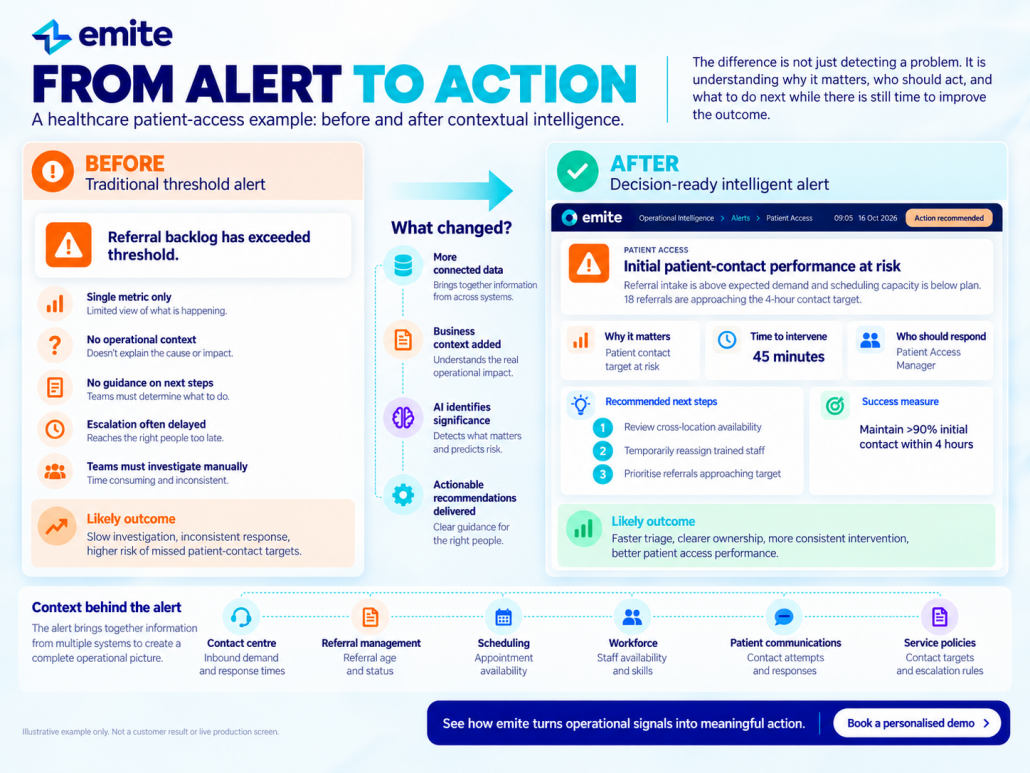

From threshold alert to decision-ready alert
The difference between the two alerts is the difference between reporting a number and supporting a decision.
| TRADITIONAL THRESHOLD ALERT
“Referral backlog has exceeded the defined threshold.” One metric. No cause, impact, owner or next step. The manager has to investigate across systems before deciding what to do. |
DECISION-READY ALERT
“Initial-contact performance is at risk within the next 45 minutes. Referral intake is above the comparable weekday baseline and scheduling capacity is below plan. Eighteen referrals are approaching the contact deadline. Recommended next steps: review cross-location scheduling capacity, consider temporary reassignment of appropriately trained staff, and prioritise outstanding contacts under established service and clinical policies.” Owner: Patient Access Manager · Reassess: 15 minutes · Success measure: >90% contacted within 4 hours |
In patient access this difference matters for a practical reason: the manager on shift is usually also handling escalations, staff questions and referrer calls. An alert that names the at-risk referrals, the capacity available at other sites and the policy boundaries lets them act in minutes rather than spending the decision window gathering information. The general structure behind this alert is covered in our article Anatomy of an Alert Worth Acting On.
The context behind the alert
A decision-ready alert is only as good as the data behind it. In this use case, six sources each contribute a different part of the picture.
| Data source | Operational context | What it contributes to the decision |
| Contact centre | Inbound demand, abandoned calls, response times | Whether patients are already feeling the pressure |
| Referral management | Referral age, status, outstanding contacts | Which referrals are closest to their contact target |
| Scheduling | Availability, booking restrictions, location | Where capacity exists and whether it can be used |
| Workforce management | Staff availability, skills, capacity | Who can be reassigned, and for how long |
| Patient communications | Contact attempts and responses | Which patients need follow-up and through which channel |
| Service policies | Contact targets, eligibility, escalation rules | Which interventions are permitted and when to escalate |
Bringing these sources together depends on good data culture: consistent definitions (what counts as “contacted”?), clear ownership of each source, reliable timestamps, and governed data flows. Those foundations are what allow an alert to combine evidence from several systems without producing a misleading picture.


Role-based intelligence across the patient access team
The same emerging condition means different things to different people. Delivering the right view to each role keeps intelligence relevant and avoids overwhelming people with detail they cannot act on.
| Role | What they need to see | Typical decision |
| Scheduling team leader | At-risk referrals in priority order; team capacity this hour | Who works which referral next |
| Patient access manager | Risk to contact targets, contributors, options, review point | Reassign staff, open cross-location capacity, escalate |
| Contact centre / workforce manager | Demand vs capacity across queues and shifts | Rebalance rosters and skills across channels |
| Operations executive | Access performance trends, exposure, intervention results | Resourcing, policy and service-design priorities |
| Data and analytics team | Alert precision, data freshness, recommendation acceptance | Refine baselines, rules and data quality |
Guardrails: keeping intelligence within clinical and privacy boundaries
Healthcare demands particular care in how operational intelligence is designed and used. Four guardrails are essential:
- Clinical authority stays with clinicians. Operational recommendations support access workflows. Clinical urgency, patient prioritisation and treatment decisions remain subject to approved clinical policies and qualified human review.
- Recommend only permitted actions. Interventions are drawn from approved workflows and service rules, with clear approval requirements for anything consequential.
- Protect patient information. Role-based access controls, data minimisation and audit trails keep health information visible only to those who need it, in line with applicable privacy obligations.
- Separate facts from inferences. Verified data (referral age, capacity) is distinguished from likely contributors, so people know what is established and what warrants checking.

Measuring what matters
A patient access intelligence programme should be judged by what changes for patients and for the operation, not just by whether alerts fire correctly.
| Measure | What it shows |
| Time to initial patient contact | How quickly referred patients hear from the provider |
| Contact-target compliance | The share of referrals contacted within the target window |
| Referral backlog age | Whether outstanding work is being cleared or ageing |
| Referral-to-appointment time | How efficiently referrals convert into booked care |
| Abandonment and repeat contacts | Whether patients are struggling to get through or chasing progress |
| Referrer follow-up enquiries | How often GPs and referrers call to chase referral status |
| Patients reached on first attempt | Whether contact timing and channel suit patients |
Where practical, a controlled rollout (for example, one service line or location first) or a matched historical baseline helps separate the effect of the intervention from normal variation.


Extending the approach across patient access
Once the data foundations are in place, the same pattern supports a range of further patient access decisions:
- Appointment backfill: recognising late cancellations and matching them to patients waiting for earlier appointments.
- Missed-appointment risk: identifying appointments where reminders have gone unanswered, so teams can follow up in advance.
- After-hours and seasonal demand: anticipating demand peaks against rostered capacity and communication readiness.
- Waitlist visibility: giving managers a current, connected view of waitlist age against service commitments.
- Post-discharge follow-up: ensuring follow-up contacts happen within the expected window.
The systems involved vary, but the principle holds across every use case: intelligence needs to understand enough of the operation to make its recommendation relevant and timely.
Three readiness checks for patient access teams
Before designing the first alert, three questions reveal whether the data foundations are in place:
- Is “contacted” defined the same way everywhere? If the contact centre counts an attempted call and the referral system counts a two-way conversation, compliance figures will disagree and alerts will lose credibility.
- Can schedulers see appointment capacity across every location in real time? Cross-location booking is often the fastest lever, and it only works when the capacity is visible.
- Can you see referral age by service line and site, not only in total? Risk concentrates in specific services and sites; a total hides where to act.
A “no” to any of these is the right first project. Once all three are in place, the Decision-Ready Alert Canvas walks a team through designing the alert itself, using this patient access scenario as its worked example.
How emite supports patient access teams
emite Advanced iPaaS joins telephony, referral, scheduling, workforce and communication data into a single operational view of patient access. Advanced Analytics applies consistent business measures and baselines, and Advanced Visualisation gives each role the view relevant to their decisions.
On top of that view, AskEmite flags emerging anomalies, explains them in context and suggests next steps, and answers follow-up questions in plain language. A patient access manager can see that a contact target is at risk, understand why, and explore the options available without waiting for a report. Your data answers back.
The key takeaway
Patient access is shaped by the relationships between demand, capacity, workforce and communication. When those relationships are visible in one place, and delivered to the right person inside the decision window, patient access teams can move from discovering problems to preventing them.
The most valuable patient access insight is the one that arrives while there is still time to reach the patient.
References
1. Experian Health, The State of Patient Access 2026, 24 March 2026 (vendor research; survey of 1,000+ patients and 200 healthcare decision-makers).
2. NIST, Artificial Intelligence Risk Management Framework (AI RMF 1.0).
The scenario and figures in this use case are illustrative and are not a customer result or live product screen. This article does not constitute clinical, legal or regulatory advice. It is not sponsored or endorsed by any organisation mentioned.