BLOG
The Human + AI Workforce Needs Role-Based Intelligence
Orchestration makes data fast. Persona is what makes it actionable for the person relying on it.

Most enterprise AI conversations start with a capability question: what can it do? A more useful starting question, and usually the real reason AI gets adopted in the first place, is a productivity one: how much time can it save me?
That reframing matters, because it’s closer to the truth of how AI actually earns its place in most organisations. It’s rarely introduced to do something genuinely new. It’s introduced to do what already happens, someone collating figures from three systems, stitching a spreadsheet together, waiting on an overnight batch job, running a complicated piece of automation code, just far faster than a person or a script could manage it alone. That work is, in effect, data orchestration: collating, analysing and serving up information that already exists but is scattered across systems.
Speeding that groundwork up is genuinely valuable. But speed on its own doesn’t make a decision timely. If the output still lands as a static report or a once-a-day digest, you’ve made the groundwork faster without making the decision any less delayed, the answer arrives sooner, but it may still land after the moment it was needed.
What closes that gap is context: taking the same orchestrated data and shaping it around the role and the decision it’s meant to support. That’s what turns a faster answer into an actionable one.
Which brings up the next question, once an organisation has more than a handful of people relying on that answer: who is it actually being served up to, and does the system know that?
An AI assistant that orchestrates every relevant data source but tells every employee the same thing hasn’t finished the job. It’s solved the speed problem and left the relevance problem behind, because relevance isn’t just about how fast the data was collated.
This isn’t a hypothetical. Take five roles inside a typical contact-centre-and-enterprise environment, all drawing on much of the same underlying, orchestrated data:

Needs: Forecast accuracy, staffing, adherence, capacity, demand, queue performance
The question might be: “Where are we most exposed against forecast this afternoon?”

Needs: Service levels, demand patterns, operational issues, capacity, process performance, customer impact
The question might be: “What is driving today’s increase in customer contacts?”

Needs: Journey performance, customer behaviour, experience trends, interaction drivers, business outcomes
The question might be: “Which customer journeys are having the greatest impact on satisfaction?”

Needs: Granular data, relationships, definitions, trends, anomalies, comparisons
The question might be: “Show me the relationship between handling-time variance, channel mix and repeat contact over the last quarter.”

Needs: Performance, business impact, risk, strategic trends, exceptions
The question might be: “What changed materially this week, and where should we focus?”
None of these people are wrong to ask a different question of the same data. They’re doing different jobs. An intelligence layer that doesn’t recognise that ends up either overwhelming people with detail they don’t need, or under-serving the people who need the detail most, no matter how quickly the underlying data was orchestrated to get there.
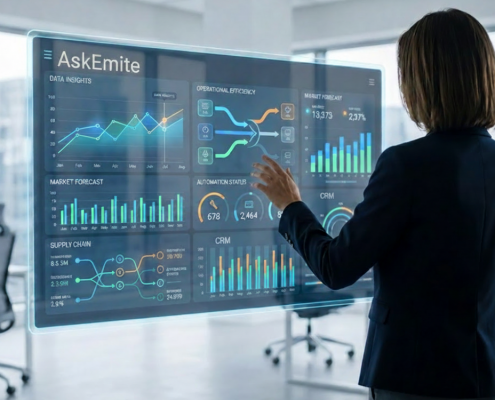
role-based personas that shape what a dashboard shows, what data is visible, and how AskEmite responds, based on who’s asking.
The orchestration layer underneath, collating and analysing data from all data sources does the heavy lifting of speed. Persona is what makes the result relevant once it arrives. It’s not simply personalisation in the sense of a friendlier interface. It’s relevance combined with control.

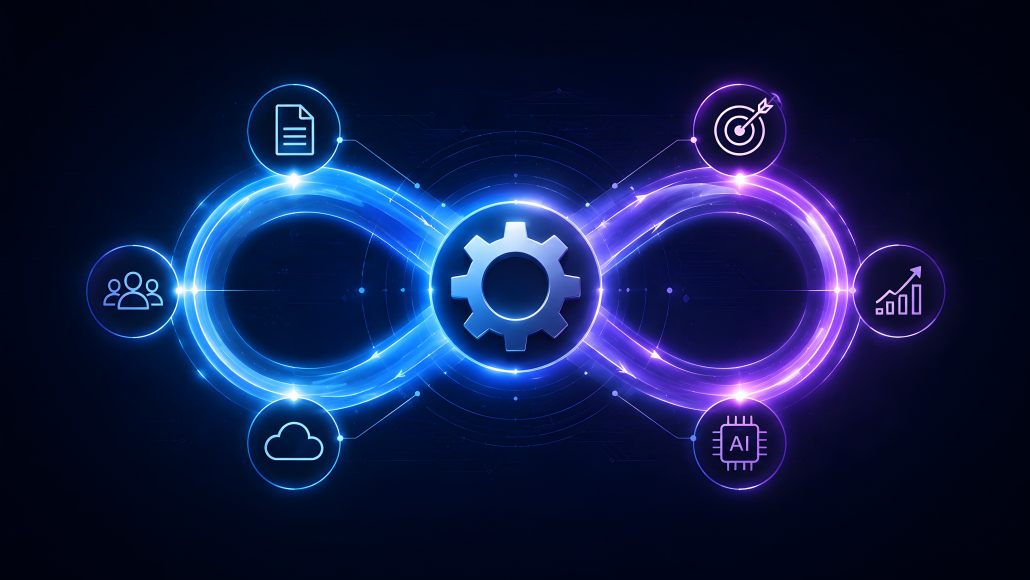
Orchestration and persona aren’t two separate improvements bolted together.
Combined, they’re what let an organisation actually harness the information already sitting inside its data, rather than just retrieving it faster. Orchestration does the work of assembling every relevant signal in one place. Persona shapes what comes back to fit the person who needs it and the decision they’re facing.
What’s left, once both are in place, is the thing organisations have wanted from their data all along: real insight, delivered in time to act on it. Not a faster version of the same static report. Not a personalised view of raw numbers. An actual answer, grounded in everything the data already knew but couldn’t previously surface quickly enough or to the right person.
Orchestration finds the signal. Persona makes it relevant. Together, they’re what let an organisation finally harness what its data has been telling it all along.
That combination is what separates having the data from understanding what it means, and knowing what to do about it, while there’s still time to act.
Persona-based access isn’t only about making AI more useful. As AI expands across more roles, it becomes one of the more practical governance mechanisms an organisation has. A role should only receive information it’s authorised to access. AI-generated responses should respect the same boundaries as everything else in the platform. Dashboards should surface the level of detail appropriate to the role, by default, not by exception.
Rather than giving everyone unlimited access to everything, deliver intelligence in the context of the person’s responsibilities.
That reframing matters because it avoids a false choice. Organisations don’t have to pick between broad AI access and tight control, persona is the mechanism that lets both coexist.

None of this is about replacing judgement with automation. If anything, the data points the other way.
McKinsey’s 2025 State of AI research found that only 27% of organisations review 100% of AI-generated content before it’s used, and 30% review less than a fifth of it — a reminder that human-in-the-loop oversight is still inconsistent industry-wide, not something that happens by default.
Persona-based access is one practical way to design that oversight in deliberately: the right person sees the right information at the right moment, rather than oversight being left to chance.
Genesys frames its own hybrid-workforce thinking in similar terms: not people versus machines, but people and AI working from a shared, role-appropriate understanding of what’s happening. Its dedicated Xperience 2026 track on the human and AI workforce is built around designing and managing exactly that kind of collaboration.
Persona-based intelligence doesn’t require rebuilding an AI strategy from scratch. It’s largely a design discipline layered onto the orchestration and data work already underway:

The goal isn’t a more personalised AI experience for its own sake. It’s the natural next step after orchestration: once the data has been collated and analysed fast, persona is what makes it actionable for the person actually making the call, and together, that’s what finally lets the organisation harness the insight that was sitting in its data the whole time.
RELATED RESOURCES