The Data Advantage #9, July 2026

Newsletter: Issue #9

DATA DEMAND IS RISING. SO IS THE BUSINESS IMPERATIVE.

Data demand is accelerating globally, but disconnected systems, changing skills and rising governance expectations are making trusted insight harder to deliver.

Welcome to the Data Advantage: Issue #9,

Information remains one of the most powerful sources of competitive advantage.

The better an organisation understands its business, customers and market, the better equipped it is to differentiate, respond and grow.

This is not a new concept but with the growing volume of data, the focus is escalating and is why organisations around the world are investing heavily in the people and technologies needed to extract more value from their data.

The World Economic Forum ranks Big Data Specialists among the fastest-growing roles globally, while AI and big data top its list of fastest-growing skills.[1]

In the United States, employment for data scientists is projected to grow by 34% between 2024 and 2034.[2]

In Australia, SEEK has forecast 27.7% growth in employment opportunities for data analysts over five years.[3]

Europe’s data analytics market is also expanding, with one industry estimate projecting growth from US$23.4 billion in 2024 to US$45.6 billion by 2030.[6]

Asia-Pacific adds further weight to this outlook. The region is expected to record the fastest growth in advanced analytics, while the broader Asia-Pacific AI market is projected to grow at a compound annual growth rate of 34.5% between 2025 and 2032.[12][13]

While market investment does not translate directly into employment growth, it demonstrates the shift and scale at which organisations are focussing on analytics, AI and data-driven decision support as a key competitive differentiator.

Across every major market, the direction is consistent.

Data is becoming more valuable, but extracting that value requires a growing combination of technology, governance, business knowledge and human judgement.

The competitive advantage no longer comes from simply having more data.

It comes from leveraging the right tools that can enable, the noise from the value add, understanding it faster and acting on it with greater confidence.

In this issue we focus on all three key areas People, Process and Technology.

Lets dive in

TL:DR

1.THE GLOBAL DEMAND FOR DATA EXPERTISE

Big Data Specialists are among the fastest-growing roles globally, while AI and big data lead expected skills growth.

The trend can be seen across every major market:

  • US data scientist employment is projected to grow by 34%
  • Europe’s analytics market is forecast to reach US$45.6 billion by 2030
  • Asia-Pacific is expected to lead advanced analytics growth
  • Australian data analyst opportunities are forecast to increase by 27.7%

The markets differ, but the direction is consistent: organisations need more people who can turn information into meaningful business outcomes.

[Lets take a deeper look and explore the global data outlook]

2.THE DATA TALENT BOOM IS ALSO A COMPLEXITY WARNING

Every new application can create another source of valuable information.

It can also introduce another integration, data structure, KPI definition, dashboard and version of the truth.

The average organisation now manages approximately 957 applications, but only 27% are connected. As a result, skilled analysts can spend more time locating, cleaning and reconciling information than interpreting it.

If we take the martech market as an example. It may be nearing saturation, with growth slowing to less than 1% despite more than 15,500 products now available.

But the apparent plateau hides significant churn. Nearly 1,500 new products entered in the market in 2026, while more than 1,300 disappeared. Growth is shifting toward areas such as integration, analytics, governance and AI-driven search, while other categories are already consolidating.

The competitive advantage is no longer having more technology. It is choosing the right platforms to reduce complexity, connect data and turn it into better business decisions.

This then, is no longer only a technology issue. Disconnected data slows decisions, hides emerging risks and makes it harder for organisations to respond to changing customer and market conditions.

[See why data complexity is a business problem – Read the full Article]

3.BEYOND THE DASHBOARD: TRUST REQUIRES PROCESS AND GOVERNANCE

A dashboard can present information clearly, but confidence depends on what happens before the data reaches it.

Clear ownership, consistent definitions, controlled access, data quality, traceability and repeatable validation all help ensure that information can be trusted and explained.

Global frameworks including DAMA-DMBOK, ISO/IEC 27001, ISO/IEC 42001, NIST and the EU AI Act differ in scope, but reinforce common expectations around accountability, transparency, risk management and auditability.

Organisations do not need a separate process for every framework. A shared governance foundation can support multiple requirements while helping teams use data and AI with greater confidence.

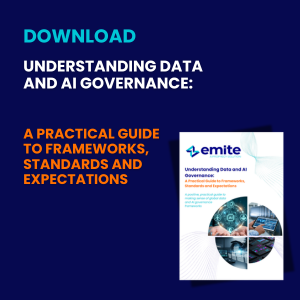
[Read the Full Article] PEOPLE, PROCESS AND TECHNOLOGY: A CONTINUOUS GOVERNANCE SYSTEM

4.THE DATA-DRIVEN CX & OPS BRIEFING

Most contact centres didn’t have an AI strategy problem in 2026. They had a data problem wearing an AI costume.

Gartner now predicts that 40% of agentic AI projects will be cancelled by the end of 2027, not because the models failed, but because the data governance, process clarity, and operational readiness underneath them never got built. McKinsey’s research points at the same wall from a different angle: as AI pilots push toward scale, only 7% of companies have fully scaled AI across their organisation, and the bottleneck traces straight back to data that was never made AI-ready in the first place.

89% vs. 33%, customer retention rate for companies with strong omnichannel execution vs. weak execution (McKinsey).

The gap between those two numbers is, in almost every case, a data governance and integration gap, not a strategy gap.

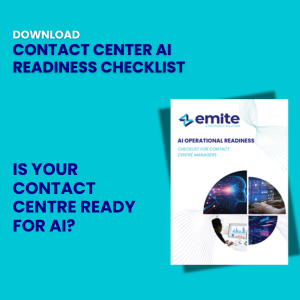
Make sure you download the Contact Center AI Readiness Checklist

5.WHAT’S MOVING IN CX & OPS

Forrester: a third of AI self-service rollouts will fail this year. Forrester principal analyst Max Ball predicts that among brands rolling out generative or agentic AI in self-service, slightly more efforts will fail than succeed in 2026, largely because cost pressure pushed deployments out before the underlying data and processes were ready, why it matters: the rush to cut cost-per-contact is, ironically, what’s producing the AI failures that cost the most to unwind.

Forrester’s State of AI survey: the ROI gap is wider than most board decks admit. Across more than 1,400 global AI decision-makers, Forrester found only 15% reported an EBITDA lift from AI in the past 12 months, and fewer than a third can tie AI’s value directly to P&L. Enterprises are expected to delay 25% of planned AI spend into 2027 as a result, why it matters: “AI adoption” and “AI value” are being measured as if they’re the same thing. They’re not, and finance teams are starting to notice.

Regulators are done waiting. The Colorado AI Act takes effect June 30, requiring impact assessments and disclosure for AI used in decisions that affect customer access to services, explicitly including customer service. The EU’s workplace emotion-recognition ban has been enforceable since early 2025, and broader high-risk provisions for customer-facing AI land August 2, why it matters: “we’ll govern it later” is no longer a viable sequencing strategy.

McKinsey: unstructured data is the part nobody’s governed properly. McKinsey’s latest research on AI data readiness finds that scaling AI requires connecting structured and unstructured data, call transcripts, notes, policy documents, into a single governed, reusable foundation, and that most organisations have only really invested in the structured half, why it matters: your WFM and CRM data might be clean. Your call transcripts and QA notes almost certainly aren’t, and that’s exactly the data your next AI initiative wants most.

WORTH YOUR TIME

6.HUMAN JUDGEMENT REMAINS THE DATA ADVANTAGE

AI can identify patterns, anomalies and relationships at a speed that traditional analysis cannot match.

Human expertise is still needed to determine whether a finding represents a temporary fluctuation, an operational issue, a customer experience risk, a regulatory concern or a commercial opportunity.

The value of AI is not in replacing human judgement. It is in giving people faster access to the evidence and context needed to apply that judgement effectively.

The strongest results come when technology and human expertise work together—not when one is expected to replace the other.

[Read the full article]

7. THE NEXT DATA CHALLENGE: SCALING TRUSTED AI

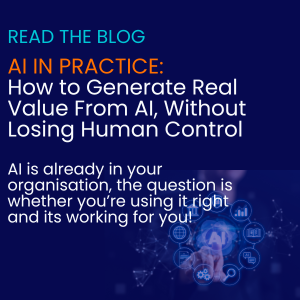
What’s been clear over the last 12 month is that AI adoption is accelerating, but adoption alone does not guarantee business value.

The organisations gaining the strongest returns from AI are distinguished not only by how much technology they deploy, but by the foundations supporting it, including connected data, governance and trust.[11]

As businesses move from isolated trials towards broader operational use, they need to know:

  • which data sources an AI-supported answer is drawing from
  • whether the data is current, accurate and appropriate
  • how metrics and business terms have been defined
  • whether access and usage are properly governed
  • whether an answer can be reviewed and explained
  • where human oversight is required
  • how AI-supported decisions affect customers and employees

The opportunity is significant.

But so is the risk of applying AI to fragmented, inconsistent or poorly governed information.

The organisations that gain the most will not necessarily be those that introduce the most AI tools.

They will be those that build a reliable data foundation and apply AI to clearly defined business problems.

Download the Single Source of Truth Diagnostic. This quick tool Assesses your data foundations for reliable analytics and AI

8.FROM FRAGMENTED DATA TO DECISION INTELLIGENCE
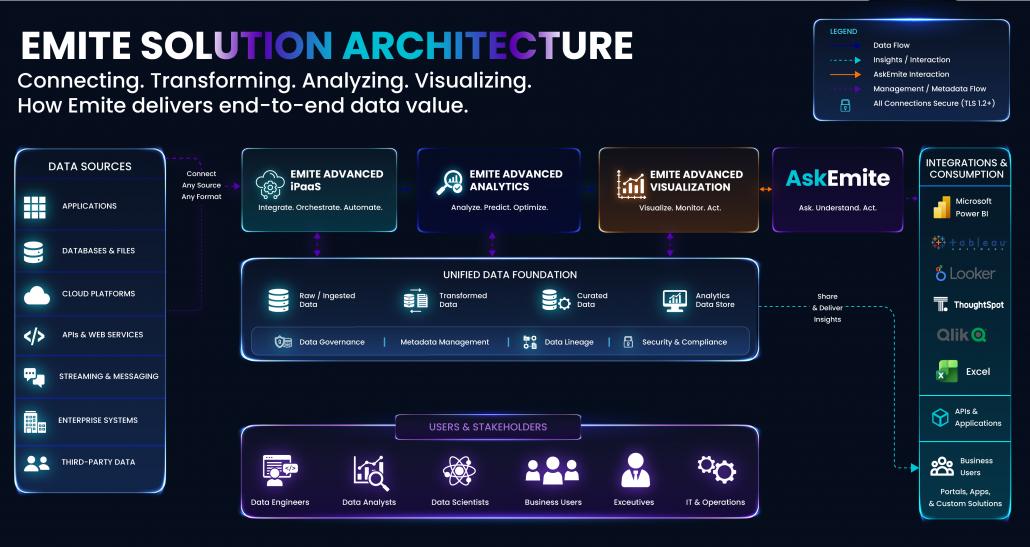
This is where emite, ProDataIQ and AskEmite come together.

emite connects information from contact centre, CRM, workforce, ERP, customer experience and operational platforms.

ProDataIQ applies intelligence across that unified data, helping transform information into relevant business context.

AskEmite enables teams to investigate performance through natural-language questions—moving beyond what happened to understand why it happened and where attention is required.

Together, they shorten the path from question to context, and from context to informed action.

[Read the Full Article to See how connected decision intelligence works]

9.FEATURE SPOTLIGHT: ASKEMITE

AskEmite: Move from reading dashboards to interrogating performance

AskEmite extends the value of the emite platform by enabling users to engage directly with the information emite has unified.

Natural-language querying

Ask business and operational questions without needing to construct a new report for every enquiry.

Persona-Based Intelligence

Configure role-based personas that tailor dashboards, data visibility, and AI responses for every user. Deliver relevant insights while maintaining governance, security, and controlled access to business information.

Cross-source reasoning

Investigate results using information from multiple platforms rather than relying on the limited perspective of one system.

KPI interrogation

Explore why a metric moved, what influenced a trend and how performance compares across teams, regions or periods.

Anomaly awareness

Surface deviations from expected patterns and provide additional context to support earlier investigation.

Explainable insight

Give users greater visibility into the information behind an answer, supporting trust, validation and informed decision-making.

Broader access to insight

Enable more people across the organisation to investigate performance while allowing data specialists to focus on higher-value analysis and strategic work.

10.THE KEY TAKEAWAY

Information remains critical to differentiation and competitive advantage.

But the advantage does not come from collecting more data, employing more analysts or producing more dashboards.

It comes from knowing more about the business, customers and market and being able to apply that knowledge before competitors do.

The global growth in demand for data professionals reflects this imperative.

It also demonstrates how difficult the challenge has become.

Europe shows how governance, privacy and explainability are raising the standard for data and AI.

Asia-Pacific shows the speed and scale at which digitalisation, analytics and AI are expanding.

The United States and Australia continue to report strong demand for people who can turn growing volumes of information into business value.

While the market dynamics differ, the underlying challenge is consistent:

Organisations have more information available, but connecting, interpreting and acting on it is becoming harder.

Adding more analysts cannot, by itself, solve disconnected architecture, inconsistent metrics or manual reporting processes.

Organisations must also give their people the right foundation:

Connected data. Consistent context. Governed intelligence. Explainable insight. Faster access to answers.

emite unifies the information.

ProDataIQ applies the intelligence.

AskEmite makes that intelligence accessible through the questions people naturally ask.

Together, they help organisations reduce the distance between information and action, giving skilled people more time to apply judgement, understand what is changing and turn data into measurable business advantage.

11.Resources

[1] World Economic Forum, Future of Jobs Report 2025
Big Data Specialists are identified among the fastest-growing roles, AI and big data lead anticipated skills growth, and analytical thinking remains the most sought-after core skill.

[2] US Bureau of Labor Statistics, Occupational Outlook Handbook: Data Scientists
Employment of data scientists is projected to grow by 34% between 2024 and 2034.

[3] Analytics Institute of Australia, Industry Outlook in Analytics
Cites SEEK’s forecast of 27.7% growth in employment opportunities for data analysts in Australia over five years.

[4] PwC, Global AI Jobs Barometer
Reports that skills in highly AI-exposed roles are changing significantly faster than in less-exposed roles.

[5] MuleSoft, Connectivity Benchmark Report
Reports that surveyed organisations manage an average of approximately 957 applications, with only 27% connected, and that data integration remains a major AI implementation challenge.

[6] Intel Market Research, Europe Data Analytics Market Outlook
Projects the European data analytics market to reach US$45.6 billion by 2030.

[7] Eurostat, Use of Artificial Intelligence in EU Enterprises
Reports that 20% of EU enterprises with at least ten employees used AI technologies in 2025.

[8] Mercer, European AI Talent Study; Colliers, Global Tech Markets
Identifies major European technology and AI talent hubs.

[9] European Commission, EU AI Act, Article 10: Data and Data Governance
Sets out data governance and management requirements for certain high-risk AI systems.

[10] PwC and World Economic Forum, Research on AI and Early Careers
Examines how AI is reshaping entry-level roles and career pathways.

[11] PwC, AI Performance Study
Highlights the importance of connected data, governance and trust in capturing measurable value from AI.

[12] MarketsandMarkets, Advanced Analytics Market
Forecasts Asia-Pacific to record the highest regional growth in advanced analytics, with India expected to have the highest country growth rate.

[13] MarketsandMarkets, Asia-Pacific Artificial Intelligence Market Forecast
Projects growth from US$102.6 billion in 2025 to approximately US$816 billion by 2032.

[14] Asian Development Bank, Southeast Asia Digital Economy Research
Reports approximately US$300 billion in gross merchandise value during 2025 and 15% year-over-year growth.

[15] Research on India’s Global Capability Centre Market
Examines the movement towards higher-value analytics, product development and strategic capabilities alongside specialised talent shortages.

[16] OECD and Korea Labor Institute, Artificial Intelligence and the Labour Market in Korea
Finds that AI adoption is increasing demand for data analysis, interpretation and social capabilities.

[17] OECD, Artificial Intelligence and the Labour Market in Japan
Identifies significant labour and skills shortages, relatively low workplace AI adoption and a need for greater AI integration and training.

emite
Privacy Overview

This website uses cookies so that we can provide you with the best user experience possible. Cookie information is stored in your browser and performs functions such as recognising you when you return to our website and helping our team to understand which sections of the website you find most interesting and useful.