Why “The Business of Data” is More Critical Than Ever
Who Owns the Data—and Who Owns What It’s Telling Us?

In today’s volatile, fast-moving business climate, data is being hailed as the new oil. But if that’s the case, why are so many businesses stalling at the starting line?
It’s not because they lack data. Most organizations are awash in it—CRM entries, operational logs, customer interactions, marketing metrics, financial systems, and more. It’s not even that the data is “bad.” In fact, the data itself is often sound.
The more data sources we connect, the more opportunities we have for misinterpretation—especially when teams have different definitions for the same KPI, or when visualizations present contradictory narratives. And when leaders can’t confidently trust the numbers in front of them, decision-making slows, strategies falter, and growth stalls.
The more data sources we connect, the more opportunities we have for misinterpretation—especially when teams have different definitions for the same KPI, or when visualizations present contradictory narratives. And when leaders can’t confidently trust the numbers in front of them, decision-making slows, strategies falter, and growth stalls.
This question is more than a governance issue. It’s a cultural and operational one. Who owns the responsibility of understanding the data? Who is accountable for ensuring that insights are unified, relevant, and timely? It’s not enough to capture and store information. The real value lies in interpreting it correctly—and acting on it decisively.
In a business environment defined by digital acceleration, compliance pressures, and customer expectation, not understanding your data—or worse, misreading it—can have massive downstream consequences.

…and Start Thinking About the Business of Data
Traditional approaches to data management often focus on integration pipelines, storage, and reporting—treating data as a byproduct of systems and services.
But forward-thinking organizations understand that data is the business. It underpins every strategy, every forecast, every customer experience. That means it’s time to elevate the conversation—from pipelines and warehouses to purpose, consistency, and alignment.
It’s important to remember that insights don’t just appear—they’re a byproduct of clean, connected, and consistently interpreted data. Without a solid foundation, even the most advanced analytics tools will generate confusion instead of clarity. Insights are only as good as the data they’re built on, and that means organizations must invest not just in tools that analyze, but in systems that align, unify, and standardize data across the board. If your data is fragmented, your insights will be too. That’s why the real value isn’t just in analytics—it’s in the architecture of understanding.
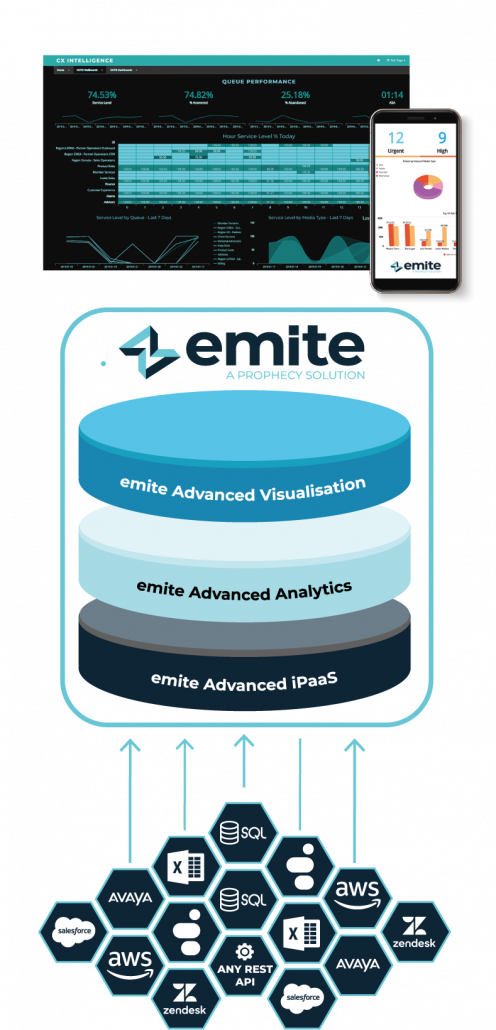
At emite, we’ve built a platform designed not just to move data, but to make sense of it. Our suite—comprising emite Advanced iPaaS, emite Advanced Analytics, and emite Advanced Visualization—was purpose-built to help organizations take control of their data story and drive intelligent action. Connect. Understand. Act.
Breaks down data silos by connecting applications, platforms, and tools across the enterprise. Real-time data aggregation ensures your business systems stay in sync—so your insights start with the full picture.
Transforms raw data into actionable intelligence. Define consistent KPIs, create unified business logic, and enable every team to work from a shared version of the truth—without waiting for developers or analysts.
Brings your data to life with dynamic, intuitive dashboards that drive smarter, faster decisions. Designed for business users, not just analysts, emite dashboards cut through the noise and illuminate the path forward.
With increasing M&A activity, remote workforces, and tech stacks evolving faster than ever, the risk of data disarray is only growing. Here are the most common pitfalls we see:


 Your Data Challenges Aren’t a Tool Problem — They’re a Strategy Probl...