Breaking Free from Data Silos: How emite Solves Key Tech Stack Challenges

Organizations today are powered by data. Yet, when this data is scattered across multiple systems within your tech stack, businesses face operational, strategic, and security issues that can cripple growth. When your essential data is fragmented across CRM tools, ERPs, marketing platforms, and analytics systems, operational efficiency, strategic decision-making, and security are often compromised. From inefficiencies and rising costs to security risks and a lack of cohesive analytics, these challenges demand immediate attention. 

The future of thriving businesses lies in seamlessly connected technologies and actionable insights. Here, we’ll explore the common challenges organizations encounter with data spread across their tech stack and how solutions like emite + emite iPaaS are transforming the way businesses integrate, analyze, and optimize operations.  

Top Data Challenges Organizations Face

1. Data Silos and Fragmentation

Problem: Data is often trapped in isolated systems—such as CRMs, ERPs, marketing platforms, and support tools—each operating independently with limited cross-visibility.

Impact: This fragmentation prevents a unified view of the customer journey, supply chain, or performance metrics. For instance, sales teams may not have access to the latest customer service interactions, leading to misalignment and reduced customer satisfaction. It also hampers strategic initiatives like personalization, predictive analytics, and operational optimization.

2. Integration Complexity

Problem: Many systems use different APIs, data schemas, and formats, making integrations difficult and error-prone. The lack of standardization results in a need for custom connectors or costly middleware.

Impact: Businesses face long lead times and inflated budgets to bring new systems online or update existing integrations. This reduces agility, delays time-to-value from new platforms, and creates long-term technical debt.

3. Latency and Real-Time Limitations

Problem: Legacy systems and batch-based processing often mean data is refreshed only periodically, leading to delays in data propagation between systems.

Impact: For functions like fraud detection, incident response, or CX optimization, these delays can be critical. Teams miss opportunities to respond in real time, leading to lost revenue, compliance issues, or customer churn.

4. Inconsistent Data Quality

Problem: Data may be entered inconsistently across departments or systems—think varying formats for dates, customer names, or SKU codes—leading to duplication or misclassification.

Impact: Teams spend extensive time cleaning and reconciling data before it can be trusted. Poor data quality also undermines analytics outputs, resulting in bad insights and poor business decisions. It also compromises regulatory reporting and compliance.

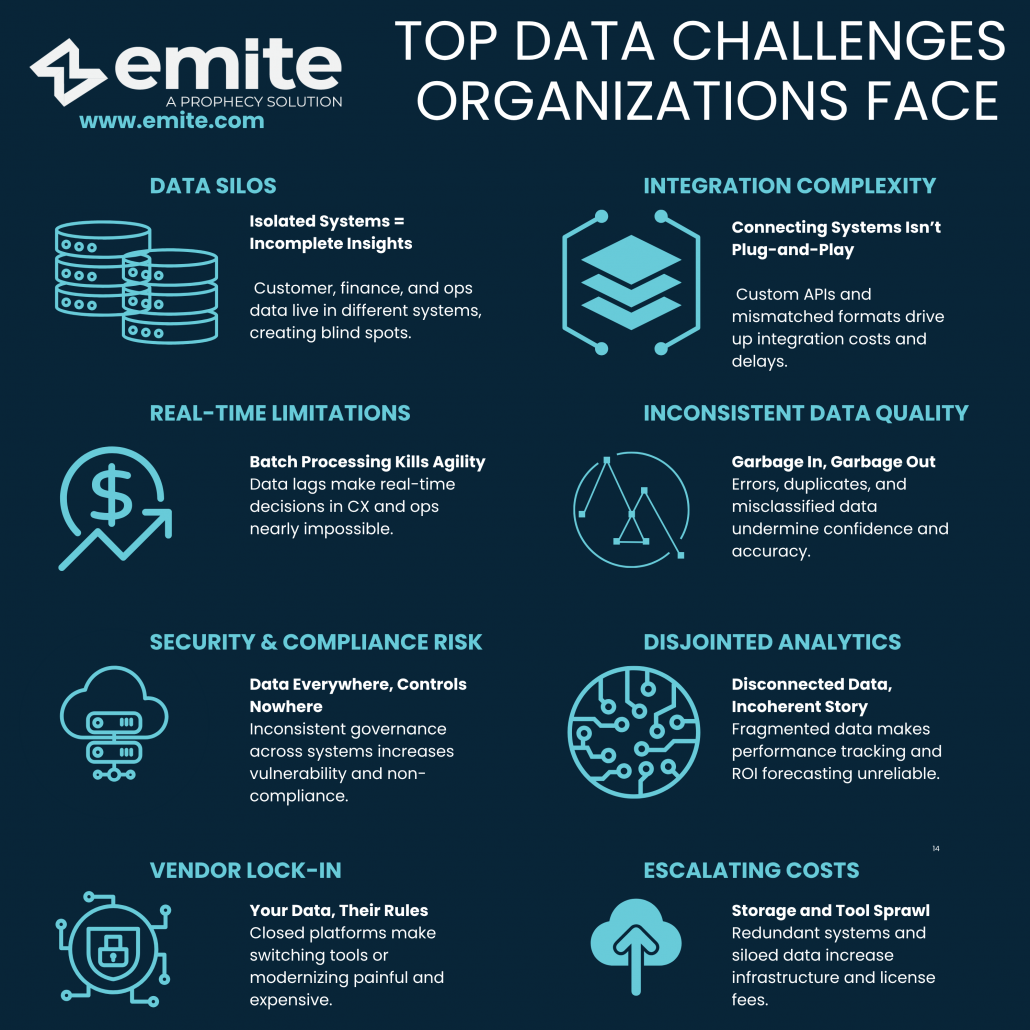
5. Security and Compliance Risks

Problem: Disparate systems with inconsistent access controls, encryption standards, and logging practices introduce security vulnerabilities and compliance gaps.

Impact: As data moves across systems or is stored in ungoverned locations, organizations face higher risk of breaches and non-compliance with frameworks like GDPR, HIPAA, or ISO standards. This can result in fines, reputational damage, and loss of customer trust.

6. Lack of Unified Analytics

Problem: Traditional BI tools struggle to pull insights from disconnected systems or reconcile conflicting data points. Analysis is often performed in silos, using extracts or spreadsheets.

Impact: Organizations lose the ability to make strategic, data-driven decisions. Forecasting becomes guesswork, KPIs become unreliable, and it becomes difficult to justify ROI on campaigns, projects, or investments.

7. Vendor Lock-In and Limited Flexibility

Problem: Proprietary platforms often restrict how data can be accessed, migrated, or exported. Once embedded, switching platforms becomes costly and disruptive.

Impact: Innovation is stifled as businesses must work around the constraints of their current vendor. They’re unable to adopt newer, more efficient tools or adapt to changing business needs without significant investment or disruption.

8. Escalating Costs

Problem: Redundant data storage, duplicate processing, and disjointed systems drive up infrastructure and license costs. Each system often incurs its own maintenance and operational overhead.

Impact: As the data estate grows, so do costs—without a corresponding increase in value. This eats into IT budgets and limits resources available for innovation and transformation.

9. Knowledge Gaps and Skills Shortages

Problem: Many organizations lack in-house expertise in data engineering, integration architecture, or advanced analytics. This limits their ability to implement and manage solutions effectively.

Impact: Companies rely heavily on external consultants or managed services, which adds cost and dependency. Projects slow down, bottlenecks appear, and transformation efforts can stall entirely.

10. Operational Inefficiency

Problem: To compensate for disconnected systems, teams often create manual workarounds—exporting CSV files, reconciling data by hand, or duplicating entry across platforms.

Impact: These inefficiencies waste valuable time, introduce human error, and slow down critical business processes. It also makes scaling operations difficult, particularly in fast-growing or regulated industries.

How emite Suite of Solutions Solves These Challenges

emite simplifies and unifies your tech stack, turning scattered data into actionable insights. Here’s how it addresses the complex challenges above: 

1. Break Down Data Silos

emite provides a centralized platform that integrates disconnected systems into one, giving you a unified view of your data. No more jumping between dashboards or relying on isolated tools. 

2. Streamline Integration Complexity

With emite iPaaS, businesses can connect systems, through real time subscriptions and REST APIs, using connector-less agile integrations. It offers real-time, and historical integrations seamlessly without the burden of coding, whilst still being configurable to meet their specific needs. 

3. Achieve Real-Time Data Accessibility

emite’s event-driven workflows ensure that data flows seamlessly and instantly between your systems. With real-time data monitoring, you’re always informed and ready to act. 

4. Enhance Data Quality

emite avoids the pitfalls of duplicate records or inconsistent data by enforcing standardized formats and entry rules. Accurate data is no longer a luxury – it’s the foundation of your strategy. 

5. Strengthen Security & Compliance

With central governance, emite guarantees consistent security measures across your systems, simplifying compliance with standards like GDPR or ISO 27001. 

6. Enable Unified Analytics

Get cross-functional insights with consolidated data visualizations and advanced analytics. emite’s dashboards provide clarity across business units, enhancing forecasting and ROI measurement. 

7. Counter Vendor Lock-In

emite ensures interoperability, giving you the flexibility to extract and migrate data as needed. You’re never stuck with one provider. 

8. Reduce Operational Costs

By eliminating redundancy and inefficiencies, emite optimizes your tech stack. Fewer tools, better data quality, and integrated workflows mean significant cost savings and higher ROI. 

9. Bridge Knowledge Gaps

Even without technical expertise, teams can manage integrations via emite iPaaS’s user-friendly framework. It empowers internal teams, reducing dependency on consultants. 

10. Boost Operational Efficiency

Automated workflows streamline operations, allowing businesses to react quickly to changes in customer needs or market trends.  

Transforming Your Organization with emite

Imagine seamless integration, real-time insights, and improved decision-making across every business function. With emite + emite iPaaS, this isn’t just idealistic–it’s achievable. 

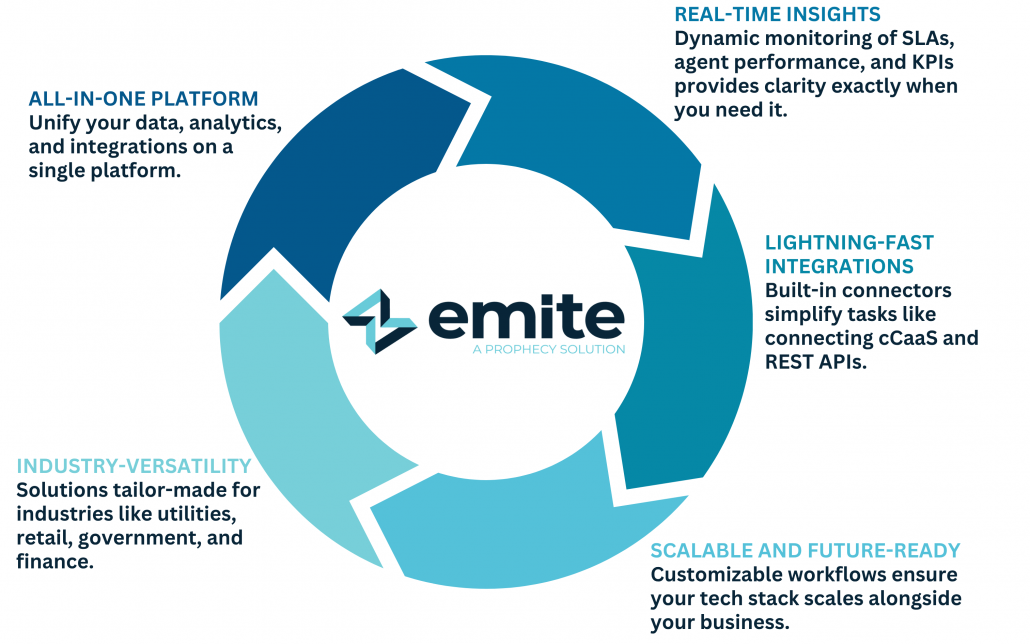
Key Benefits of emite Solutions:

How It Works (Fast, Simple Steps):

Take Your Data Strategy to New Heights

If your technology stack feels disconnected and difficult to manage, or if you’re tired of operational bottlenecks caused by delayed or missing information, emite + emite iPaaS offers a reliable path to integration, insight, and optimization.  

Every moment your systems operate in silos is a missed opportunity for growth. emite + emite iPaaS is your trusted partner to connect, optimize, and reshape how your organization uses data. 

Transform your business today and unlock your potential for smarter, faster, and data-driven decisions.  

Request a demo today and unlock the full potential of emite iPaaS