The Hidden Challenge of API Rate Limits: Navigating the Data Deluge

In the world of modern customer experience (CX), businesses need data, and lots of it. And, they need it in real time, from multiple sources, all while making sure it’s insightful and actionable. That sounds great until you run into an inconvenient truth: application programming interface (API) rate limits. 

Alright, brace yourself, we’re about to dive into the science bit of API rate limits; however, don’t worry, we’ll keep it light and, dare we say, fun.  

Dashboarding versus analytics: a quick refresher

Before jumping into the deep end, let’s set the stage. Many businesses confuse dashboarding with analytics. Dashboards provide a snapshot of key metrics; think of them as a car’s speedometer, showing real-time readings. However, analytics is more like a full diagnostic system that uncovers patterns, predicts issues, and guides future decisions. This is where the real data challenges start to emerge. 

The business problem: the pipe is only so big

Every organization today wants instant data, and the faster, the better. Unfortunately, APIs don’t exist in a vacuum; they are subject to rate limits to protect infrastructure, maintain fair usage, and manage server load. Providers set these limits for good reasons: 

  • Protecting performance: APIs are shared resources, and a single overzealous request pattern could slow things down for everyone without limits. 
  • Managing infrastructure costs: infinite requests would increase server and bandwidth expenses dramatically, making API usage impractical. 
  • Keeping systems stable: handling concurrent requests effectively prevents downtime and failures. 

 This means businesses need to balance: 

  • What needs to be instant? Some decisions depend on data arriving within a second. 
  • What is still useful at a slight delay? Does getting information in 15 seconds versus one second truly impact the outcome? 
  • What can be adjusted to work smarter? Often, data that’s already available can be used differently instead of requesting everything instantly. 

For example, imagine a real-time dashboard tracking agent availability. You need instant updates on how many agents are active now, though there’s no need for a live count every millisecond. Understanding the difference between real-time and low-latency data is key. 

Real-time versus low-latency: know the difference

Many businesses assume real time means faster, though real-time data isn’t necessarily the quickest option. It’s simply an immediate snapshot. Here’s the difference:

  • Real-time data: provides a live view of the current state, like how many agents are online at that moment. This works well for instant visibility, though it doesn’t help with historical trends, explaining `why’ or feed accurate predictions.
  • Low-latency data: delivers updates with minimal delay, staying within a practical timeframe. For example, tracking customer wait times in a contact center may not require updates every second. A five-to-10-second delay could still provide useful insights while keeping system resources in check.

Low latency is often a better fit for business operations, providing near-instant updates without overwhelming API resources. The key is deciding what truly needs real-time access versus what can tolerate slight delays while still adding value. Since every business has unique needs, experienced professionals can help guide this process.

The growing challenge of API rate limits

As CX operations expand and demand for data grows, companies increasingly run into API rate limits. But what do these limits mean for users? 

How rate limits impact API users

APIs enforce rate limits to keep systems running smoothly for everyone. If an API is overloaded, it can slow down performance, disrupt services, or even block access altogether. Here’s why rate limits matter: 

  • Faster performance: avoids slow response times and service disruptions due to system overload. 
  • Reliable access: distributes resources fairly, preventing a single user from consuming too much and affecting others. 
  • Cost control: reduces unnecessary requests that could drive up costs, especially with usage-based pricing. 
  • Consistent data: prevents redundant queries that might return outdated or conflicting information. 

Understanding these limits helps businesses optimise API usage while keeping systems efficient and reliable. 

Solving the rate limit puzzle: pagination; batching; and caching

These three techniques help businesses work around API constraints while still accessing the data they need. 

  1. Pagination: retrieves data in smaller chunks, like flipping through the pages of a book, instead of pulling all data at once, which triggers rate limits. 
  2. Batching: groups multiple requests into a single, more efficient request. Think of it as ordering a tray of coffees instead of placing separate orders. 
  3. Caching: stores frequently accessed data so that repeated API requests aren’t necessary. If you checked the weather five minutes ago, there’s no need to ask again immediately. The last response is likely still valid. 

Enter emite iPaaS: smarter solutions for API rate limits

 emite Integration Platform as a Service (iPaaS) takes things a step further with our API Rate Enhancer, a game-changer for businesses drowning in data demands.  

How the API Rate Enhancer works

Imagine an action that fetches data for 100 mapped entities, where each one requires an additional API request for more details. Normally, that would mean 100 separate API calls, which could easily exceed the rate limit. 

With API Rate Enhancer, instead of sending 100 requests at once, the process is optimized: 

  1. Requests are grouped by UserId, or another relevant identifier. 
  2. One request per unique UserId is sent first. 
  3. Once those requests are complete and their data is cached, the remaining requests follow. 

This adjustment can reduce API calls from 100 down to 20, lowering the risk of hitting rate limits significantly. 

Activating the API Rate Enhancer

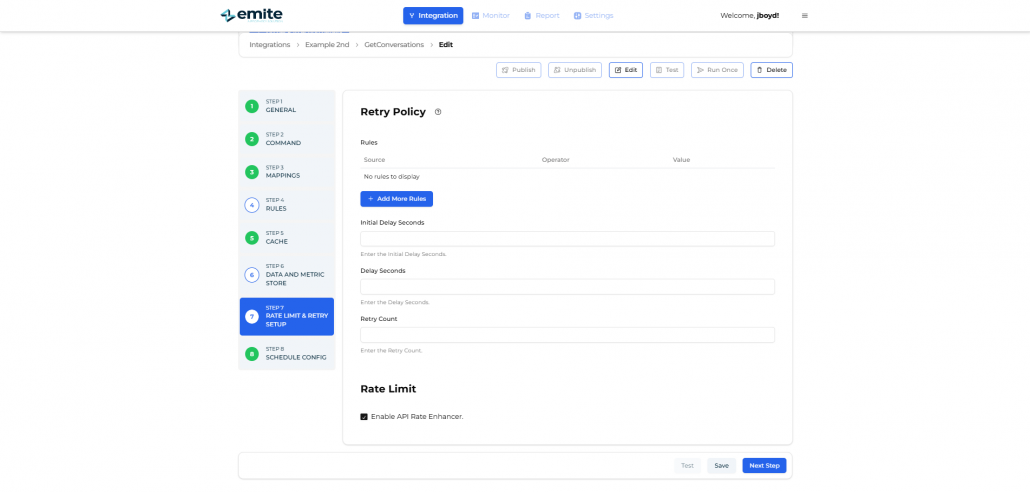
To tun on this feature, simply configure your action like this:

By default, this stays off. Once activated, emite iPaaS adjusts API calls dynamically based on cache status and data grouping, improving efficiency. 

Why this matters for your business

Rate limits aren’t going away anytime soon, and businesses need smarter ways to manage data flows as APIs become the backbone of modern digital operations. emite iPaaS lets businesses: 

  • Optimize API usage to prevent disruptions. 
  • Reduce redundant queries to save time and money. 
  • Maintain real-time insights even when API limits apply. 

Final thoughts: navigating the data maze

So, the next time someone talks about API rate limits as just a tech issue, remind them it’s a business challenge, too. Whether you’re running a contact center, analyzing CX trends, or integrating multiple data sources, an effective API management approach makes all the difference. 

And, if you want to stop worrying about hitting API ceilings, you know where to find us.