
Newsletter Article
There is no single technology called an “enterprise context layer.”
It is better understood as an architectural capability spanning integration, metadata, semantics, governance and retrieval.
A practical architecture can be considered across seven layers — and it maps directly onto how emite, ProDataIQ and AskEmite work together, as the map below shows.

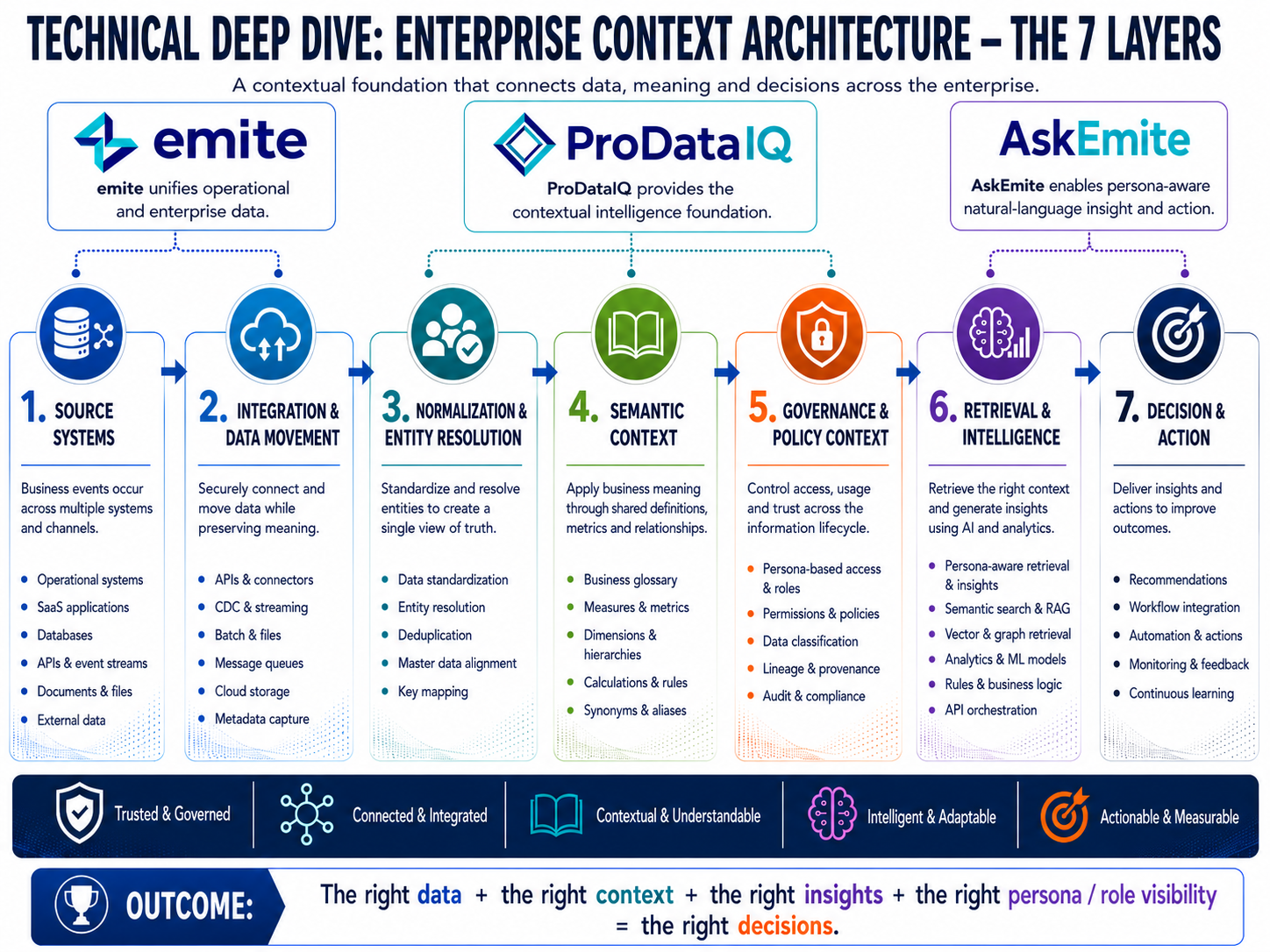
Layer 1 — Source Systems
The architecture begins with the systems where business events occur.
These can include:
- CRM
- ERP
- contact center platforms
- workforce management
- finance systems
- data warehouses
- SaaS applications
- operational databases
- APIs
- event streams
- documents
- object storage
- external datasets
A fundamental design principle is that context does not eliminate source systems.
Systems of record remain systems of record.
The challenge is allowing intelligence to operate across them.
Layer 2 — Integration and Data Movement
Before context can be created, data must be accessible.
Enterprise integration may include:
- APIs
- event-driven integration
- CDC
- streaming
- JDBC
- webhooks
- files
- message queues
- cloud storage
- batch pipelines
The important architectural consideration is preserving enough source information to retain meaning.
Over-transformation can sometimes be as damaging as under-transformation.
If identifiers, timestamps, relationships or source metadata disappear during ingestion, downstream systems may struggle to reconstruct context later.
Integration should therefore preserve not only values, but also the attributes required to interpret those values.
Layer 3 — Normalization and Entity Resolution
Different systems describe the same real-world objects differently.
A customer may appear under:
- a CRM account ID
- a billing ID
- an email address
- a phone number
- an interaction ID
- a support account
- a contract identifier
Entity resolution determines that these records relate to the same entity.
Without this step, an AI system may have access to every relevant data source yet still fail to build a coherent view of the customer.
Normalization similarly ensures that differences in formats, timestamps, currencies, naming and structures do not create false inconsistencies.
Layer 4 — Semantic Context
This is where technical data begins acquiring business meaning.
Instead of exposing:
tbl_int_245.status_cd
the semantic layer might expose:
Interaction Outcome
Instead of requiring every consumer to calculate: completed transactions minus reversals minus test transactions, the architecture exposes an agreed metric:
Net Completed Transactions
Semantic models can also encode:
- measures
- dimensions
- hierarchies
- calculations
- aliases
- synonyms
- business rules
- relationships
This becomes particularly valuable for natural-language interfaces because users ask questions using business language, not database schemas.
| This is the function ProDataIQ’s semantic layer performs inside emite deployments — turning operational fields into the business language contact centre and operations teams already use. |
Layer 5 — Governance and Policy Context
A technically correct result may still be inappropriate.
The architecture therefore needs to determine:
- user identity
- persona
- role
- organization
- tenant
- data classification
- permitted fields
- permitted actions
- applicable policies
For AI systems, retrieval itself should increasingly become policy-aware.
A document being relevant to a query does not automatically mean the user should receive it.
Similarly, an AI agent having technical access to a system does not necessarily mean it should be permitted to perform every available action.
The context architecture therefore becomes an enforcement point between what is possible and what is appropriate.
Layer 6 — Retrieval and Intelligence
Only after the previous layers are established does the AI layer become genuinely powerful.
Depending on the question, an intelligence service might combine:
- structured queries
- semantic search
- RAG
- vector retrieval
- knowledge graphs
- time-series analysis
- statistical models
- machine learning
- rules
- API calls
The objective is not to send every available piece of enterprise data to an LLM.
It is to assemble the minimum sufficient context required to answer the question accurately.
Too little context creates incomplete answers.
Too much creates noise, latency and unnecessary cost.
Context engineering therefore becomes a retrieval optimization problem as much as an AI problem.
| AskEmite operates at this layer: translating a natural-language question into the retrieval and reasoning steps described above, drawing on only the minimum sufficient context needed to answer it accurately. |
Layer 7 — Decision and Action
The final layer is where context produces value.
A traditional system may display:
Service level: 71%.
A contextual intelligence system might determine:
Service level fell below target primarily because demand in two queues exceeded forecast by 23% while available staffing was 11% below plan. Similar demand patterns occurred on the previous two Mondays. Reallocating four appropriately skilled agents would return projected service level above target.
The underlying data existed in both examples.
The difference is context.
As systems become more autonomous, the final step may move beyond recommendation toward action.
That increases the importance of every layer beneath it.
The more authority AI receives, the stronger its context foundation must become.