
USE CASE
Scaling Self-Service Analytics Without Losing Control in an Enterprise B2B Organisation
A global enterprise B2B organisation operating across multiple regions sought to expand self-service analytics to reduce reliance on central data teams and accelerate decision-making. Sales, marketing, finance, customer success, and operations leaders all required faster access to performance data — particularly as AI-enabled tools were introduced to assist with forecasting, pipeline analysis, churn prediction, and revenue reporting.
The organisation’s objective was clear: empower business users with direct access to insights while maintaining alignment, consistency, and executive trust.
However, as access expanded, complexity increased.

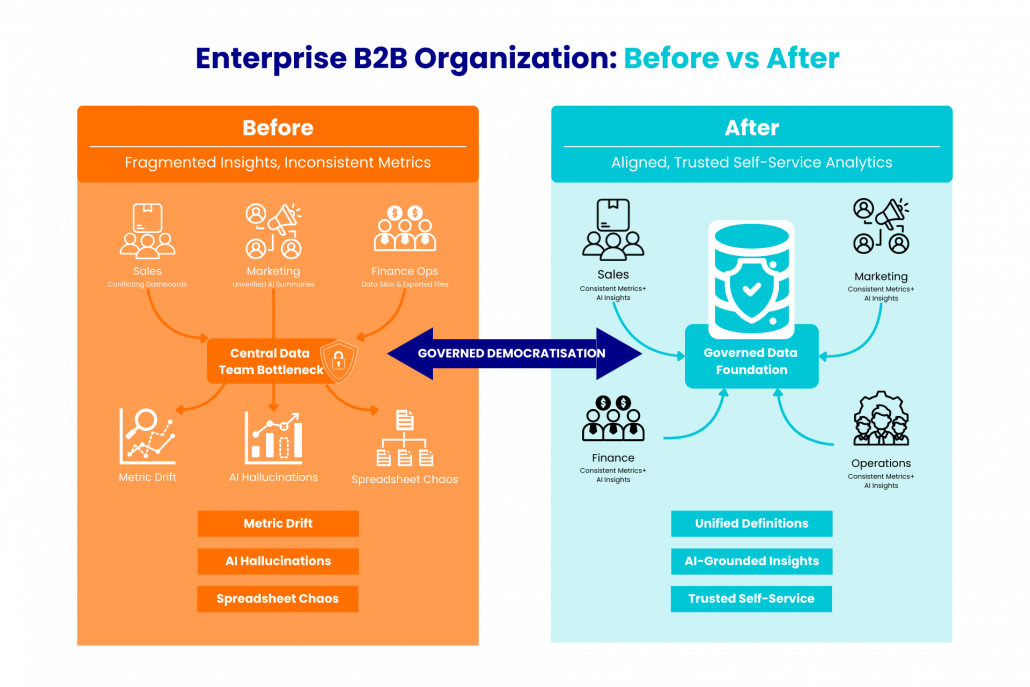
THE CHALLENGE:
Within months of rolling out broader analytics access and AI-assisted reporting tools, several issues emerged:
- Revenue and pipeline metrics were interpreted differently across regions.
- AI-generated summaries varied depending on the data context and prompts used.
- Business users were exporting data into separate tools for further analysis, creating parallel interpretations.
- Governance policies existed but were not embedded into data processing workflows.
- Conflicting dashboards began appearing in executive meetings.
None of these issues were immediately catastrophic but together they signalled a loss of consistency and control.
The organisation faced a familiar paradox:
The more access it provided, the more fragmentation appeared.
Required Outcomes:
To scale self-service analytics safely, the organisation needed to:
- Standardise enterprise metric definitions across regions and business units.
- Ensure AI-enabled insights were grounded in enterprise-approved data.
- Apply business rules during data processing — not just at the reporting layer.
- Detect inconsistencies and drift early.
- Maintain executive confidence in shared performance metrics.
- Expand access without expanding risk exposure.
Self-service needed to become structured not restricted.
How the emite Platform Helped
The emite Platform enabled the organisation to expand access while strengthening control.
1. Unified Data Processing (Advanced iPaaS)
Data from CRM, ERP, marketing automation, and customer platforms was consolidated through governed processing flows. Human-defined business rules were applied upstream to standardise revenue, pipeline, and performance definitions before analytics consumption.
2. Context-Enforced Analytics
emite ensured enterprise-approved metrics were embedded within analytics outputs, reducing regional interpretation variance.
3. AI Interaction Anchored to Trusted Data
AI-assisted summaries and insights were grounded in consistent, validated data sources — reducing hallucination risk and prompt inconsistency across teams.
4. Observability & Drift Monitoring
Monitoring mechanisms identified changes in data behaviour or definition inconsistencies early, preventing minor discrepancies from spreading across dashboards.
The organisation did not reduce access — it improved structure.
Measurable Impact
Within nine months, the organisation achieved:
- Elimination of conflicting executive dashboards
- 20% reduction in time spent reconciling performance metrics
- Improved cross-regional metric consistency
- Greater confidence in AI-assisted reporting outputs
- Increased adoption of self-service analytics across business units
Self-service analytics became scalable because governance was embedded upstream — not layered on after insight generation.
Performance & Governance Snapshot
- ↑ Increased business user adoption of analytics tools
- ↓ Reduced duplicated reporting efforts
- ↑ Executive confidence in revenue metrics
- ↓ Reduced inconsistency across regional reporting
- ✓ Full traceability of metric definitions and transformation logic
Executive Takeaway
In enterprise B2B environments, self-service analytics drives speed but only governance sustains trust.
Access can scale.
Consistency must scale with it.