
Newsletter Article
Real-time data has become synonymous with better decision-making.
But speed alone does not create intelligence.
Consider a contact center experiencing a sudden rise in abandonment.
A real-time dashboard might show:
14.2%
Abandonment:
That information is current.
But it still lacks context.
A useful decision may require knowing:
- normal abandonment for this time and day
- forecast call volume
- actual call volume
- current staffing
- scheduled breaks
- average handle time
- queue-specific performance
- whether another channel has failed
- whether a campaign generated unexpected demand
- whether the issue has happened before
Only then does 14.2% become meaningful.
From real-time to right-time intelligence
The objective should therefore not simply be real-time data.
It should be:
the right data + the right context + the right time.
Some decisions genuinely require millisecond-level information.
Others require a five-minute operational window.
Some require twelve months of historical context.
A compliance investigation may require years of information.
Good architecture needs to understand the difference.
The same applies to AI.
Giving an AI model the latest data does not guarantee the best answer if historical patterns, thresholds or related events are missing.
The future of enterprise intelligence therefore requires architectures capable of combining:
Live state — what is happening now.
Historical context — what normally happens.
Business context — what the data means.
Decision context — why the user is asking.
Only when those layers come together can an organization move from monitoring events to understanding them.
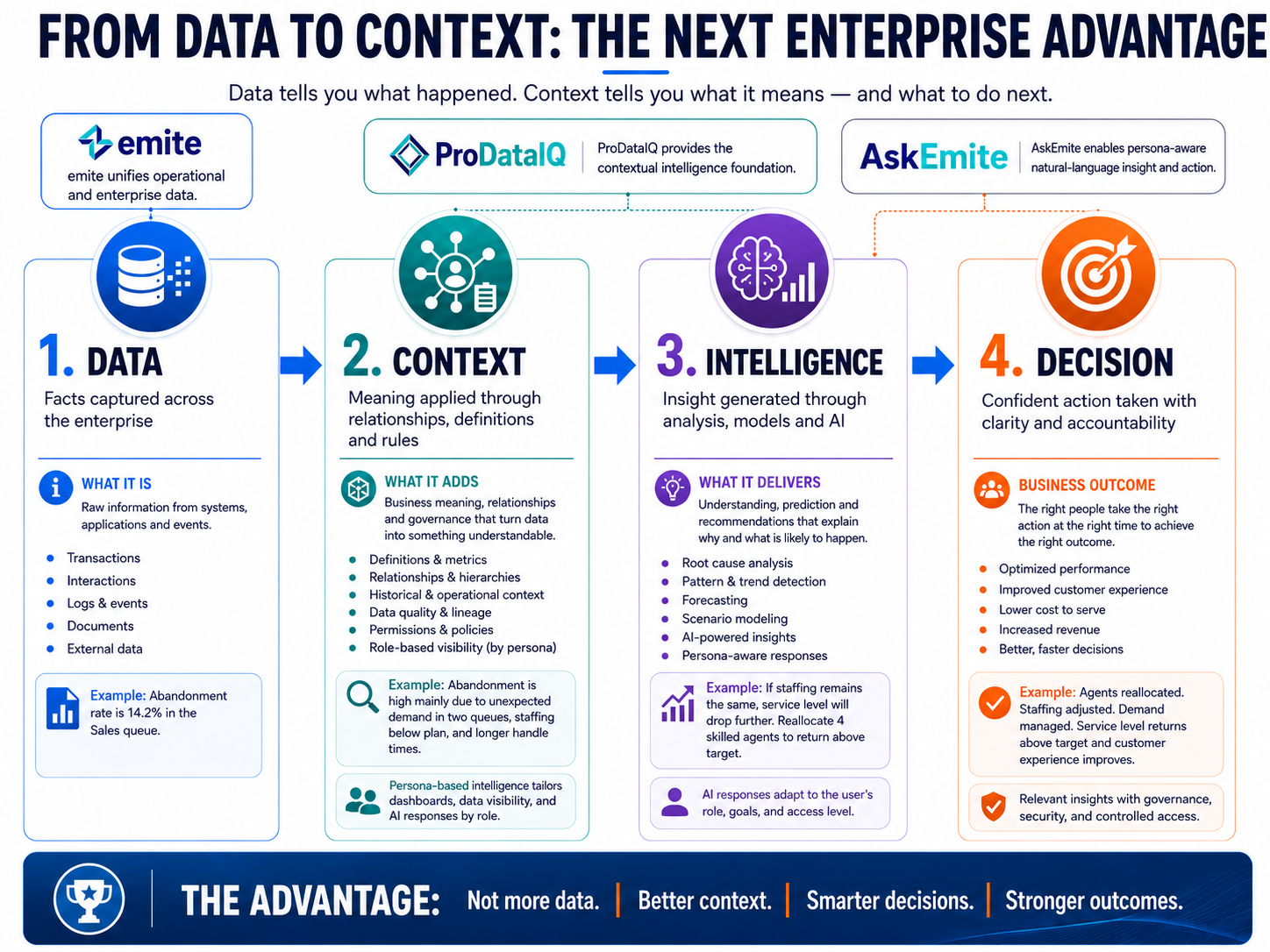
This is the model ProDataIQ is built around. It brings live state, historical pattern and business context together inside a single operational data layer, so a figure like 14.2% abandonment arrives already connected to forecast, staffing and whether the same pattern occurred last Monday.
AskEmite lets a manager ask for that context directly, in plain language, and get the right-time answer rather than just the real-time number. Your data answers back — with enough context to act on it.