BLOG

From data rich to insight ready:
the FSI data problem

Most financial services organisations have never had more data. But most are still making decisions on last week’s numbers. Here’s why — and what the fastest-moving banks are doing differently.

There’s a paradox at the heart of modern financial services. Banks, insurers, and financial institutions generate extraordinary volumes of data every single day — customer interactions, transaction records, contact centre logs, CRM updates, compliance events. By almost any measure, they are among the most data-rich organisations on earth.

And yet, when you ask a Head of Operations at a major bank how long it takes to get a reliable, cross-platform performance view to the executive team, the answer is almost always the same: too long.

Weeks, sometimes. Often involving spreadsheet exports, manual reconciliations, and at least one heated email thread about whose numbers are right.

This is the data paradox of financial services — and it’s costing institutions more than most realise.

Why the data problem persists in FSI

The root cause isn’t a lack of technology. Most banks have invested heavily in data infrastructure. The problem is architectural: every major system in a financial services organisation was built to do one job well, not to share data easily with everything else.

Core banking platforms — many of which were built decades ago — were designed for transaction processing, not data sharing. Contact centre platforms like Genesys or Avaya were optimised for call routing, not analytics integration. CRM systems like Salesforce track customer relationships, but rarely talk in real time to the platforms handling those customers’ actual service interactions.

The result is a landscape of isolated data silos, each with its own data model, update cadence, and definition of what a “customer” or a “case” actually is. When you try to bring these sources together, you don’t just get a data integration problem — you get a data truth problem.

14hrs

average time per week spent on manual reporting in large contact centres

73%

of FSI data leaders cite siloed systems as their primary analytics barrier

35

conflicting data versions typically presented in a single executive meeting

The human cost is real too. Operations teams spend hours every week extracting, cleaning, and reconciling data that should be flowing automatically. Data analysts build the same reports repeatedly in slightly different ways for different stakeholders. And when a compliance team needs an audit trail, they’re often piecing it together manually from multiple disconnected systems.

“When your regulators ask for a consistent view of customer interactions or complaints handling — which system do you point them to?”

The compliance dimension

In most industries, the data silo problem is primarily an efficiency issue. In financial services, it’s also a regulatory risk.

APRA’s CPS 234 requires that institutions maintain information security in proportion to the importance of the data — but more fundamentally, regulators across the board expect that institutions can produce consistent, traceable data on demand. When ASIC or APRA comes asking about complaints handling, responsible lending practices, or AML/CTF event logs, the answer needs to come from one coherent source — not from three separate platform exports that tell slightly different stories.

The problem is that manual, silo-based reporting creates exactly the inconsistency that regulators scrutinise. Data that was aggregated in a spreadsheet by a human analyst is, by definition, harder to audit than data that flows directly from a system of record through a governed integration layer.

What regulators are looking for

  • Consistent data definitions across systems and reporting periods
  • Auditable data lineage — where did this number come from?
  • Timely incident detection and reporting — not discovered in a weekly extract
  • Demonstrated control over data quality and integrity

None of these are achievable if your reporting process relies on manual data pulls and analyst reconciliation. The compliance argument for a unified data layer isn’t just about efficiency — it’s about risk management.

The IT bottleneck

Most financial services organisations have a well-intentioned but deeply frustrated IT team sitting between the data problem and a solution.

The challenge is structural. Large banks are often mid-way through core banking transformation programmes that have been running for three, five, sometimes ten years. Every new data integration request gets added to a backlog that’s already years long. The business wants real-time dashboards. IT says it’s 18 months away. The business builds a spreadsheet workaround. The spreadsheet becomes load-bearing infrastructure. The problem compounds.

What’s changed in the last few years is the emergence of genuinely no-code integration and analytics platforms — tools that allow operations and CX teams to build and manage their own data connections, KPI definitions, and dashboards without writing code and without competing for IT resource.

This isn’t about replacing IT. It’s about removing the bottleneck for use cases that don’t require bespoke development — which turns out to be the majority of operational analytics needs.

What the fastest-moving banks are doing differently

The institutions making the most progress on this problem share a few common characteristics. They’re not necessarily the largest or the most technically advanced. They’re the ones that have stopped trying to solve the data problem by building more bespoke infrastructure, and started solving it by connecting what they already have.

  1. They’ve built a unified integration layer

Rather than building point-to-point integrations between every system (a combinatorial nightmare), the most effective approach is a centralised integration platform that connects every source once — and then makes that data available to every downstream consumer. Changes to one system don’t cascade into broken integrations across the business.

  1. They’ve separated data ownership from IT delivery

Operations leaders, CX teams, and compliance functions own their KPI definitions. They don’t need to raise a ticket every time a metric changes or a new dashboard is needed. IT’s role shifts to governance and security oversight — which is where their expertise genuinely adds value — rather than being the bottleneck for every analytics request.

  1. They’ve moved from periodic to real-time reporting

Weekly reports are a relic of a world where data was expensive to move. Real-time KPI visibility isn’t just faster — it changes behaviour. When a contact centre supervisor can see a queue building in real time, they can act on it. When they find out in Friday’s report, they write a note for next week’s meeting.

  1. They’ve standardised their data definitions

This sounds unglamorous, but it’s the work that unlocks everything else. What is a “resolved complaint”? What counts as a “handled interaction”? When every team is working from the same definitions — enforced at the data layer, not just documented in a wiki — the arguments about whose numbers are right stop happening.

“The goal isn’t more data. It’s one version of the truth that every team in the business can trust — and act on — in real time.”


How emite solves this for financial services

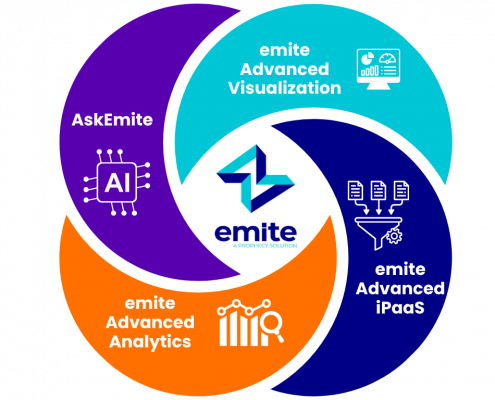
emite is a no-code data platform built to do exactly what the fastest-moving financial institutions are doing — at a fraction of the time and cost of building it yourself.

With 300+ pre-built connectors covering the full FSI technology stack — Genesys, Salesforce, SAP, core banking APIs, Verint, NICE, AWS, and more — emite creates a unified real-time data layer across your entire organisation. Your operations team defines the KPIs. Your contact centre leaders see live performance. Your board gets the consistent, auditable view they need for governance and regulatory reporting.

And because it’s no-code, your IT team doesn’t have to build any of it. Deployment is typically measured in days, not months.

What emite delivers for financial services

  • Real-time unified view across contact centre, CRM, core banking, and operations systems
  • 300+ pre-built FSI-compatible connectors — Genesys, Salesforce, SAP, AWS, and more
  • No-code KPI builder — operations teams define metrics without IT dependency
  • Auditable data lineage for APRA, ASIC, and internal governance requirements
  • Live in days — not months — with dedicated FSI onboarding support
  • Trusted by ANZ, Commonwealth Bank, QBE Insurance, and Toyota Financial Services

Next steps

The data paradox in financial services is solvable. The institutions that solve it first will have a genuine operational and competitive advantage — faster decisions, lower compliance risk, and teams that spend their time acting on insight rather than arguing about it.

The question isn’t whether you need one source of truth. It’s how long you can afford to operate without one.

See emite in your environment

Book a 30-minute demo and see how emite unifies your FSI data stack in real time.

emite
Privacy Overview

This website uses cookies so that we can provide you with the best user experience possible. Cookie information is stored in your browser and performs functions such as recognising you when you return to our website and helping our team to understand which sections of the website you find most interesting and useful.