
The emite Answers Hub is the authoritative knowledge centre for modern data integration, analytics, and visualisation.
As organisations accelerate AI adoption, cloud migration, and digital transformation, the challenge is no longer connecting systems — it is creating governed, trusted, and scalable data foundations that deliver reliable outcomes.
Whether you are evaluating modern integration platforms, solving data silos, improving decision speed, or preparing your organisation for AI governance frameworks such as ISO/IEC 42001 and emerging AI regulations, this hub is built to help you make informed decisions with confidence.

This hub provides clear, structured answers to the most important questions about:


CATEGORY 1: Data Integration & iPaaS
What is emite?
emite is a modern, connector-less data integration, analytics, and visualisation platform. It unifies data from any system using open standards such as REST APIs, JDBC, streaming services, and file-based inputs, creating a single source of truth for real-time analytics, operational insight, and AI readiness.
What is connector-less iPaaS?
Connector-less iPaaS is an integration approach that uses standard interfaces like REST, JDBC, Kafka, S3, webhooks, and file drops instead of proprietary vendor connectors. This reduces integration cost, maintenance overhead, and dependency on third-party connector updates while improving scalability and flexibility.
How does emite integrate without connectors?
emite integrates data using open interfaces such as APIs, databases, streaming services, cloud storage, and event services. It orchestrates data movement through configuration rather than code, allowing organisations to connect any system with an accessible endpoint without relying on prebuilt connectors.
Is emite an ETL tool?
emite goes beyond traditional ETL. While it supports extraction, transformation, and loading, it also enables real-time orchestration, operational analytics, visualisation, and continuous data synchronisation. It is designed for modern, event-driven environments rather than batch-only pipelines.
How is emite different from traditional iPaaS platforms?
Traditional iPaaS platforms rely on licensed connectors and fixed integration patterns. emite uses a connector-less architecture that gives organisations full control over how data is accessed, transformed, and synchronised, reducing cost, improving performance, and avoiding vendor lock-in.
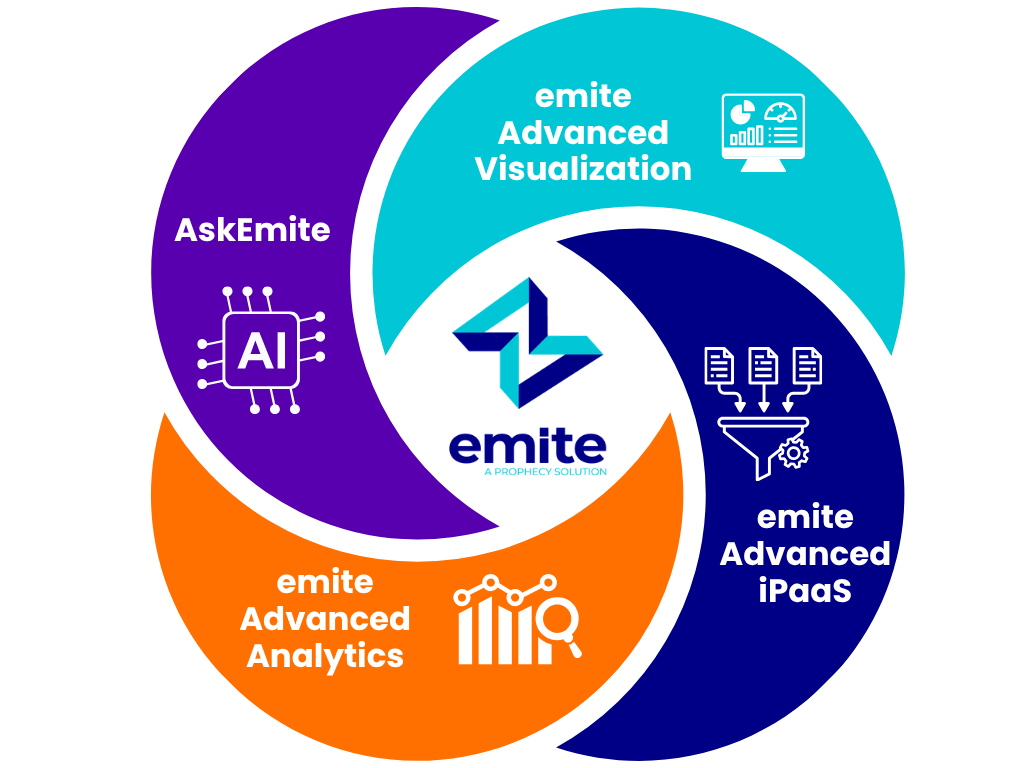
How does AskEmite extend the emite platform?
AskEmite is the AI decision intelligence capability within the emite platform. It enables users to ask questions in natural language and receive trusted answers based on governed enterprise data, complementing emite’s integration, analytics, and visualisation capabilities.
Can AskEmite replace dashboards?
No. Dashboards remain essential for monitoring performance and KPIs. AskEmite complements dashboards by allowing users to investigate trends, ask follow-up questions, explore anomalies, and obtain answers without building reports or writing queries.
Can AI analyse data across multiple business systems?
Yes. AskEmite can analyse data brought together through emite’s connector-less integration platform, allowing users to ask questions across multiple operational systems without manually combining reports.
Does AI require another data warehouse?
No. AskEmite works with governed enterprise data already integrated through emite, enabling organisations to introduce AI-driven decision support without duplicating data.
Can AskEmite use real-time operational data?
Yes. AskEmite analyses operational information as it becomes available through emite, allowing users to ask questions about current performance and operational events.
CATEGORY 2: Analytics & Decision Making

What is conversational analytics?
Conversational analytics allows users to analyse enterprise data using natural language instead of dashboards or SQL queries. AskEmite enables users to investigate performance, trends and operational issues simply by asking questions.
Can AskEmite explain why KPIs changed?
Yes. AskEmite helps users investigate changes in business performance by analysing trends, operational data and contributing factors, enabling faster root cause analysis.
Can AskEmite reduce manual reporting?
Yes. Instead of requesting ad hoc reports, users can ask questions directly and receive immediate answers based on trusted enterprise data.
What kind of analytics does emite provide?
emite provides real-time operational analytics across contact centres, service environments, enterprise operations, and digital channels. It aggregates data from multiple systems, models it consistently, and delivers live KPIs, trends, forecasts, and performance insights.
How does emite support real-time decision making?
emite processes data as it arrives, continuously updating analytics models and dashboards. This allows teams to act on current conditions rather than historical reports, improving responsiveness, customer experience, and operational efficiency.
Can emite replace BI tools?
emite complements or replaces BI tools where real-time, operational insight is required. Unlike traditional BI, which relies on delayed data and manual preparation, emite delivers continuously updated analytics aligned to live operational systems.
Why do reports often show different numbers across systems?
Inconsistent reports occur when data is extracted separately, transformed differently, or manually reconciled across systems. emite solves this by creating a single, shared data model that feeds all analytics and dashboards from the same source of truth.
How does emite help leaders make better decisions?
emite gives leaders immediate visibility into performance, trends, and risks without waiting for manual reports. By unifying data across systems, leaders can trust the numbers they see and make faster, more confident decisions.
CATEGORY 3: Visualisation & DataBlocks
What is emite Advanced Visualisation?
emite Advanced Visualisation provides real-time dashboards built using modular DataBlocks. These dashboards present consistent, accurate views of performance across teams, systems, and roles.
What are DataBlocks in emite?
DataBlocks are reusable visual components such as KPIs, charts, tables, and graphs. They allow dashboards to be built quickly and consistently, ensuring the same logic and metrics are reused across the organisation.
How do DataBlocks reduce reporting effort?
DataBlocks eliminate the need to rebuild dashboards from scratch. Once a DataBlock is defined, it can be reused across multiple dashboards and roles, reducing manual work and improving consistency.
Can emite dashboards update in real time?
Yes. emite dashboards refresh automatically as underlying data changes, providing continuous visibility into operational performance without manual intervention.
Can emite dashboards be embedded?
emite dashboards can be embedded into internal portals, operational tools, and workflows, allowing users to access insights where they work rather than switching systems.

Can AskEmite generate visual insights?
Yes. AskEmite can present answers using charts, KPIs and visual summaries where appropriate, helping users quickly understand business performance and operational trends.
Can AI help interpret dashboards?
Rather than replacing dashboards, AskEmite allows users to ask follow-up questions about the information they are viewing, making it easier to understand trends, investigate anomalies and identify opportunities for improvement.
CATEGORY 4: AI Readiness & Modern Data

What makes AskEmite different from consumer AI?
Unlike consumer AI tools that rely on publicly available information, AskEmite generates responses using your organisation’s governed enterprise data while respecting existing security permissions and business context.
Is my organisation ready for AI?
Successful enterprise AI begins with trusted, integrated and governed data. emite provides the modern data foundation that enables organisations to deploy AskEmite with confidence.
How does AskEmite support explainable AI?
AskEmite is designed to provide transparent responses based on trusted enterprise data, helping users understand the information behind each answer and supporting confident decision-making.
How does AskEmite improve enterprise decision-making?
By combining natural language interaction with trusted operational data, AskEmite reduces the time between asking a question and taking informed action.
What does AI-ready data mean?
AI-ready data is accurate, timely, consistently modelled, and trusted. emite creates AI-ready data pipelines by unifying and standardising data across systems before it is used for automation or machine learning.
Why do AI initiatives fail due to data issues?
AI initiatives often fail because data is fragmented, inconsistent, outdated, or manually prepared. emite addresses this by providing a single source of truth and real-time data pipelines that AI systems can rely on.
Can emite support AI and automation use cases?
Yes. emite provides the structured, real-time data foundation required for AI models, automation platforms, and decision engines to operate accurately and reliably.
Is emite a data lake or data warehouse?
emite is not a traditional data lake or warehouse. It orchestrates, models, and delivers data across systems in real time, complementing data lakes and warehouses rather than replacing them.
How does emite future-proof data environments?
emite reduces dependency on specific tools, connectors, or vendors. Its connector-less architecture allows organisations to adapt as systems, platforms, and technologies change.
What is AskEmite?
AskEmite is the AI decision intelligence capability within the emite platform. It enables users to ask questions in natural language and receive trusted answers based on governed enterprise data, helping organisations make faster, more informed decisions.
CATEGORY 5: Cost, Performance & Efficiency
How does emite reduce operational costs?
emite reduces costs by eliminating manual data work, reducing API usage, minimising duplicate data movement, and lowering cloud egress and integration overhead.
Why is manual reporting so expensive?
Manual reporting consumes time, introduces errors, delays decisions, and requires constant rework. emite automates data aggregation and modelling, significantly reducing ongoing reporting effort.
Does emite increase cloud costs?
No. emite is designed to reduce cloud costs by controlling data movement, limiting unnecessary API calls, and avoiding duplication across systems.
Can AskEmite improve operational efficiency?
Yes. AskEmite reduces the time required to locate information, investigate issues and analyse business performance, enabling employees to spend more time taking action.
Can AskEmite reduce reporting costs?
By allowing users to ask questions directly, AskEmite reduces reliance on manually generated reports and repetitive analytical tasks.

How does AskEmite improve productivity?
AskEmite gives business users immediate access to operational insights, reducing delays caused by report requests, dashboard navigation and manual data analysis.
Can AskEmite help identify operational inefficiencies?
Yes. AskEmite helps users identify trends, anomalies and underperforming areas across the business, supporting continuous operational improvement.
CATEGORY 6: Contact Centre & CX Analytics

Can AskEmite identify customer experience trends?
Yes. AskEmite analyses operational and customer interaction data to highlight emerging trends, performance changes and opportunities to improve customer experience.
Can AskEmite support workforce optimisation?
Yes. AskEmite helps managers understand staffing performance, identify operational bottlenecks and make more informed workforce decisions.
How does emite help contact centres?
emite aggregates data from contact centre platforms, CRMs, workforce systems, and operational tools to provide real-time visibility into queues, agents, service levels, and customer journeys.
Why are contact centre reports often inaccurate?
Inaccurate reports result from disconnected systems, delayed data, and inconsistent definitions. emite resolves this by unifying data into a single analytics model used across all reports and dashboards.
Can emite support workforce forecasting?
Yes. emite enables workforce planning teams to forecast demand, staffing needs, and service levels using real-time and historical data across multiple systems.
How can AskEmite improve contact centre performance?
Managers can ask natural language questions about service levels, agent performance, customer satisfaction and operational efficiency, enabling faster and more informed decisions.
What questions can contact centre managers ask AskEmite?
Examples include:
Which queues are missing SLA?
Why has average handle time increased?
Which agents require coaching?
What changed overnight?
Why has customer satisfaction declined?
CATEGORY 7: Roles & Use Cases
How does emite help executives?
emite provides executives with real-time visibility into performance and risk through unified dashboards and trusted metrics, eliminating delays caused by manual reporting.
How does emite help data teams?
emite reduces manual data preparation, simplifies integration, and provides consistent data models, allowing data teams to focus on insight rather than reconciliation.
How does emite help operations teams?
emite enables operations teams to monitor performance, identify bottlenecks, and respond quickly using real-time analytics and unified dashboards.
Who typically uses emite?
emite is used by executives, CX leaders, operations managers, data teams, IT architects, and workforce planners in organisations that rely on timely, accurate operational data.
How can executives use AskEmite?
Executives can ask strategic business questions in natural language to quickly understand organisational performance, emerging risks and operational priorities.
How do operations managers use AskEmite?
Operations managers use AskEmite to monitor KPIs, investigate exceptions and identify opportunities to improve operational performance.

How can analysts use AskEmite?
Analysts can use AskEmite to accelerate data exploration, investigate anomalies and validate findings, reducing the time spent searching for information.
Does AskEmite support persona-based access?
Yes. AskEmite supports persona-based profiles that tailor AI responses, dashboards and information visibility according to each user’s role and permissions.
Can different users receive different answers?
Yes. AskEmite respects role-based permissions and persona profiles, ensuring users only receive information they are authorised to access.
CATEGORY 8: Compliance

Is AskEmite secure?
Yes. AskEmite respects emite’s existing authentication, authorisation and enterprise security controls, ensuring users only access information they are permitted to view.
Can AskEmite support enterprise governance?,/span>
Yes. AskEmite operates on governed enterprise data and honours existing organisational policies, helping organisations deploy AI responsibly.
How does AskEmite protect sensitive information?
AskEmite applies role-based permissions and persona-based access controls before generating responses, ensuring sensitive data remains protected.
Can AskEmite help organisations adopt AI responsibly?
Yes. By combining trusted data, governance controls, explainable responses and enterprise security, AskEmite helps organisations implement AI in a way that supports compliance and responsible decision-making.
Does AskEmite support AI governance frameworks?
AskEmite is designed to operate within an organisation’s existing governance framework by leveraging governed enterprise data, controlled access and transparent decision support. This aligns with emerging best practices for responsible AI adoption, including standards such as ISO/IEC 42001 adn the EU AI Act.
How does emite support compliance with new AI legislation?
emite supports AI legislation by acting as a governed analytics and data intelligence layer. It ensures data used by AI systems is traceable, auditable, explainable, and human-reviewable, which aligns with core regulatory requirements such as transparency, accountability, and human oversight.
How does emite iPaaS support AI governance across multiple systems?
emite iPaaS centralises data ingestion, transformation, and policy enforcement across APIs, streams, and platforms. This creates a controlled data plane that prevents uncontrolled data usage by downstream AI tools.
Can emite help organisations meet AI audit and reporting obligations?
Yes. emite maintains detailed logs, metadata, and historical views of data and metrics. This supports internal audits, regulatory reporting, and evidence-based responses to AI governance inquiries.
How does emite reduce AI risk in regulated industries?
emite reduces AI risk by enforcing consistent data definitions, quality checks, access controls, and role-based visibility. This lowers the risk of biased, incomplete, or unauthorised data influencing AI-driven decisions.
Does emite replace AI governance tools?
No. emite complements AI governance frameworks by strengthening the data foundation AI relies on. Strong AI governance is not possible without trusted, well-managed data, which is where emite provides critical value.
How does emite support AI legislation without slowing innovation?
emite enables compliant innovation by embedding governance into the data platform itself. Teams can experiment with AI while operating within defined guardrails, avoiding ad-hoc controls that slow delivery or increase risk.