Integration Without Limits: Why the Future of Data Depends on Connector-less Architecture

The old connector model is collapsing. Here’s how modern enterprises are breaking free.

For years, organisations believed the secret to fast integration was simple:

just add more connectors.

Connector libraries grew. ETL vendors expanded catalogues. iPaaS platforms competed on who had 300, 500, or 1,000+ pre-built integrations.

But here’s the uncomfortable truth every data team eventually discovers:

Connectors are slowing you down more than they’re helping you.

They break.
They age.
They lag behind API updates.
They lock you into rigid patterns.
They create governance blind spots.
And they force you to wait — on vendors, on patches, on upgrades, on fixes.

In a world where data moves faster than organisations can, connectors are becoming the biggest bottleneck in the enterprise.

The next generation of integration is already here — and it doesn’t rely on connectors at all.

The Problem: Connectors Can’t Keep Up With Modern Complexity

Today’s data landscape isn’t just complex — it’s volatile.

Businesses have to integrate:

  • SaaS tools that update themselves weekly
  • APIs that change without warning
  • Event streams from cloud platforms
  • On-prem systems that were built before APIs existed
  • Partner ecosystems across multiple clouds
  • Real-time operational data that can’t wait for nightly jobs

A pre-built connector model can’t keep pace with this rate of change.

When the world moves faster than your connectors can update, your integrations fail.

That leads to:

  • broken pipelines
  • data inconsistencies
  • failed governance audits
  • analytics drift
  • increased operational risk
  • constant rework for data teams

And that’s before AI enters the picture.

AI requires more speed, more structure, more reliability, and more trust than traditional ETL was ever built to support.


Why Connector-less Integration Wins

Why Connector-less Integration Wins

Connector-less architectures solve the core issue at the heart of modern integration:

They eliminate the dependency on vendor-built connectors completely.

Instead of waiting for a connector to be built, updated, or fixed, teams can integrate anything, from anywhere, at any time.

A connector-less iPaaS (like emite) can ingest and deliver data through:

  • REST endpoints
  • Webhooks
  • JDBC
  • Event streams (Kafka, Kinesis, EventBridge)
  • Cloud storage buckets (S3, GCS)
  • File drops
  • Legacy systems
  • Hybrid and multi-cloud architectures

No connector library required.
No vendor lead time.
No brittle middleware sitting between your systems and your data.

This is where integration finally becomes unlimited.

Event-Driven, Schema-Flexible, Real-Time Data Movement

Connector-less integration is not just more flexible — it’s smarter and more future-proof.

✓ Event-driven architecture

Data moves instantly, triggered by real-world changes — not by batch schedules.

✓ Schema evolution built in

When a source system changes its schema, the pipeline adapts automatically.

✓ Real-time transformations

Data is cleansed, enriched, and re-shaped in motion.

✓ Multi-cloud support

Data from AWS, Azure, Google Cloud, hybrid environments — all equally integrated.

✓ Governance by design

Every transformation, routing decision, and access point is traceable.

This is the architecture required for:

  • real-time reporting
  • AI and automation
  • operational intelligence
  • enterprise analytics
  • compliance-grade governance

Traditional ETL simply can’t compete.

From Integration Projects to Integration Agility

Most organisations measure integration work in weeks or months.

But with a connector-less architecture, teams can:

  • onboard new systems in hours
  • adapt to business changes instantly
  • merge acquisitions quickly
  • experiment with new data sources
  • support new AI models without rebuilding pipelines
  • scale analytics without re-architecting

This is integration as a capability — not a project.

When integration becomes unlimited, so does innovation.

How emite Delivers Integration Without Limits

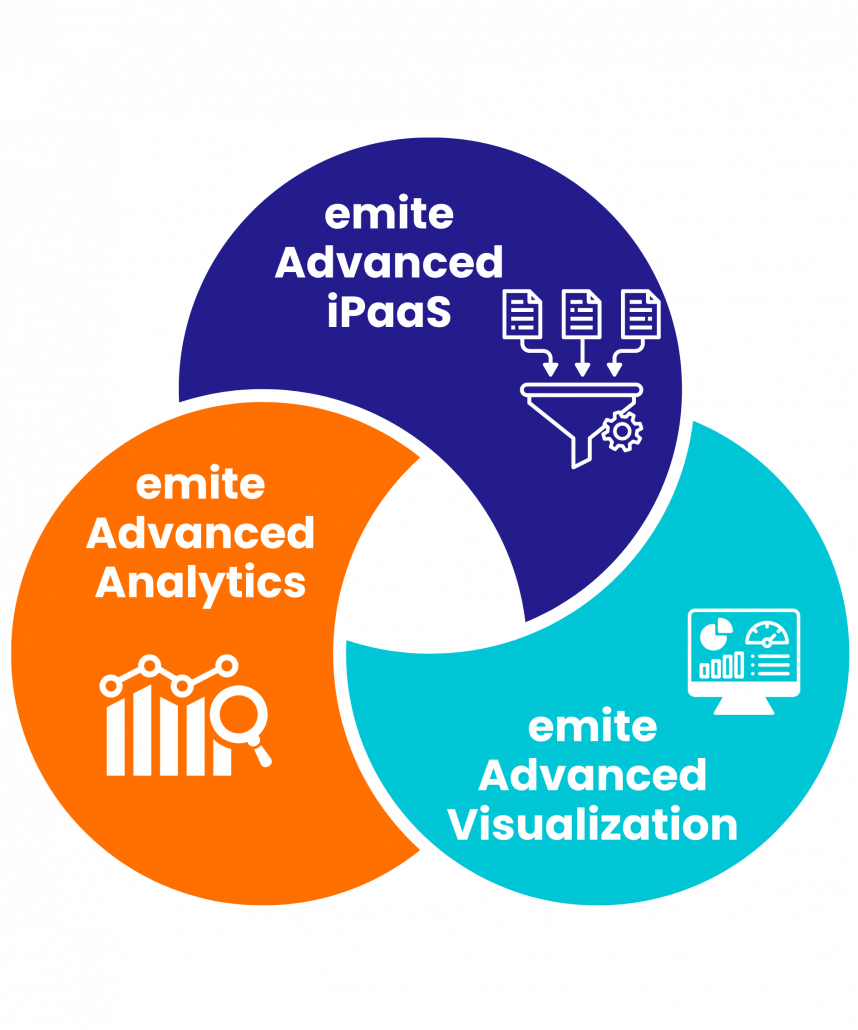
emite’s Advanced iPaaS is built for one purpose:
to make integration so agile, scalable, and frictionless that data silos simply cannot survive.

It does this through:

  • connector-less ingestion
  • event-driven pipelines
  • manifest-based schema mapping
  • native multi-cloud support
  • governance and lineage built into every workflow
  • real-time analytics and visualisation tightly integrated with the data layer

As an example for one customer this means teams can:

  • ingest millions of records per day
  • scale from 2.5K to 4K EPS and beyond
  • correlate 120M+ events daily
  • deploy integrations in hours
  • unify operational, customer, and financial data
  • move from dashboards → decisions → automated actions

No connectors. | No delays. | No limits.

The Future of Integration Will Be Connector-less — and Context-Driven

The era of connector-based integration is ending.

Enterprises need architectures that:

  • scale without vendor bottlenecks
  • adapt instantly to change
  • unify context across the business
  • support real-time AI-driven automation
  • secure and govern data end-to-end

Connector-less integration is no longer a nice-to-have —
It is the foundation of data-driven competitiveness.

And it unlocks what every organisation wants next:

  • consistent analytics
  • AI-ready pipelines
  • automated operations
  • faster decisions
  • unified context
  • reduced cost and complexity

This is integration without limits.

Conclusion: Break the Connector Bottleneck Before It Breaks You

The pace of change in modern enterprises is accelerating.
Your data architecture must accelerate with it.

If every new system, cloud service, or dataset depends on someone building a connector, you’ll never be fast enough to compete.

Connector-less integration changes that.
emite delivers it.

This is how you eliminate data silos, fuel AI readiness, and build a data ecosystem that can evolve as fast as your business.

Book a call with an emite Specialist

emite
Privacy Overview

This website uses cookies so that we can provide you with the best user experience possible. Cookie information is stored in your browser and performs functions such as recognising you when you return to our website and helping our team to understand which sections of the website you find most interesting and useful.