BLOG

Why AI Outcomes Depend on Data Quality

Artificial Intelligence succeeds or fails on the strength of its data foundation and its ability to learn continuously. While enterprises rush to deploy AI to automate processes, personalise experiences and drive smarter decisions, too many initiatives underperform — not simply because the models are weak, but because they’re built on static, incomplete or unobservable data streams. In a world of constantly shifting variables, the real differentiator is a wide, real-time and observable data layer that lets AI models refine, adapt and stay accurate.


When it comes to AI, the old saying rings true: garbage in, garbage out.

The High Cost of Bad Data in AI

Poor data quality doesn’t just weaken analytics — it creates risk. Biased or inaccurate data leads to flawed predictions, bad customer experiences, and even regulatory exposure. Consider:

Customer experience: Inconsistent data across systems can cause AI-powered chatbots to give the wrong answers or recommendations.

Operational efficiency: If data isn’t real-time, AI engines may base resource allocations or forecasts on stale inputs.

Compliance risk: Errors in regulatory or financial data can quickly snowball when automated across decision-making processes.

Beyond data quality, there’s a deeper issue: algorithm fragility. Most machine learning models were designed for static datasets. They’re brittle when faced with live, high-variance data, and without mechanisms to observe, measure and retrain, their accuracy decays quickly.

Generative AI and emerging Agentic AI models magnify this challenge, they depend on diverse, real-time signals to keep their learning cycles alive.

Predictive models will always be “wrong” to some degree; what makes them useful is the ability to continually ingest new data, compare outcomes against ground truth and recalibrate fast.

Why Data Quality Is Harder Than Ever

In today’s enterprise environment, data lives everywhere — across SaaS apps, cloud services, legacy platforms and business units that rarely speak to each other. Silos create fragmentation. Manual integrations introduce errors. By the time information reaches your AI engine, it’s often inconsistent, stale or already out of sync with the real world.

This complexity only multiplies as organisations expand globally, adopt new technologies or merge with other businesses. The more moving parts, the harder it becomes to create a single, trusted source of truth. In a world of constant change and streaming data, building a resilient, observable data foundation isn’t just a “nice to have” — it’s the prerequisite for AI that works.

Building a Strong Data Foundation for AI

AI doesn’t simply need more data — it needs better, broader and observable data. That means:

Unified sources:

Connecting data across systems, geographies and teams into a single, trusted platform.

Consistency:

Standardising metrics so the same measure means the same thing everywhere.

Real-time access:

Continuously updating data to reflect business reality, not last week’s snapshot.

Governance and observability:

Putting in place controls and transparency to ensure integrity, diagnose drift and maintain accountability across the data lifecycle.

When these foundations are in place, AI systems stop guessing and start delivering accurate, explainable and actionable outcomes. Predictive models become less brittle, Generative and Agentic AI can sustain their learning cycles, and human decision-makers gain visibility into how models behave.

How emite Makes AI Work the Right Way

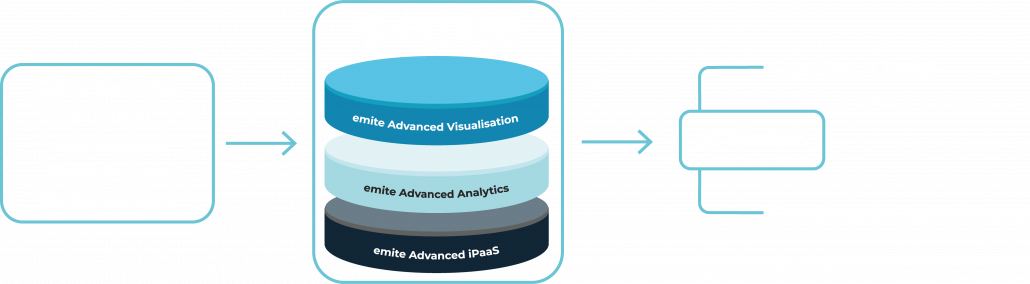
At emite, we believe AI is only as strong as the data and observability foundation beneath it. Our platform unifies data from across the enterprise into a single, consistent source of truth — with real-time integration, advanced analytics and visualisation that business leaders and AI models can trust.

Connectorless integration via iPaaS:

Eliminates the complexity of stitching systems together and feeds AI models with high-volume, high-velocity data.

Advanced analytics and observability:

Provide consistent insights and a clear view of model performance for both human and machine decision-making.

Real-time dashboards and feedback loops:

Ensure that Generative and Agentic AI models are always fed with the freshest, most reliable inputs and can self-correct quickly.

THE RESULT: AI outcomes you can rely on, built on data you can trust — with the closed-loop feedback and transparency needed to keep models accurate and business-ready.

Final Thought

AI adoption is no longer optional — but the winners won’t simply be the companies with the most sophisticated algorithms. They’ll be the ones with the cleanest, most unified and most observable data foundation, and the ability to refine their AI continuously.

Because in the end, good AI doesn’t just start with good data. It starts with trusted, real-time, observable data — and the infrastructure to keep it that way.

emite
Privacy Overview

This website uses cookies so that we can provide you with the best user experience possible. Cookie information is stored in your browser and performs functions such as recognising you when you return to our website and helping our team to understand which sections of the website you find most interesting and useful.