Understanding Analytics Types: Descriptive, Prescriptive, Diagnostic, and Predictive

Analytics play a crucial role in gaining insights from data to drive informed decision-making. There are four main types of analytics: descriptive; prescriptive; diagnostic; and predictive. Understanding these types can empower you to extract valuable insights and help your organization optimize its processes. Partnering with an experienced provider can help your organization develop the necessary knowledge and understanding internally, preventing rework and minimizing value leakage from projects.


The four main types of analytics

To fully leverage the power of data, it’s essential to understand these four primary analytics types. Each type offers unique insights and capabilities that can significantly enhance your decision-making processes and customer experience. By doing so, you can ensure that your business is making informed decisions and delivering a superior experience to your customers.

1. Descriptive analytics

Descriptive analytics focuses on summarizing historical data to understand what has happened in the business. It involves collecting and analyzing data to uncover patterns, trends, and correlations.

Example: In a contact center environment, descriptive analytics can provide insights into historical call volumes, customer demographics, and agent performance metrics. This helps in identifying trends and making informed decisions for future operations.

2. Prescriptive analytics

Prescriptive analytics goes beyond describing past events to recommend actions to optimize outcomes. It leverages data and mathematical algorithms to suggest the best course of action based on historical data and integrates this with descriptive and diagnostic insights.

Example: In a contact center context, prescriptive analytics can highlight optimal staffing levels or surface personalized responses to customer inquiries for human analysis. It provides highly configurable key performance indicators (KPIs), which are defined to offer management governance for expected behaviors and outcomes derived from descriptive and diagnostic methods. This ensures that management can effectively guide operations and achieve desired results by surfacing key insights for human analysis and decision-making.

3. Diagnostic analytics

Diagnostic analytics identifies the root causes of trends and incidents by analyzing data to understand why certain outcomes occurred and what factors contributed to them. It provides actionable insights that integrate with descriptive approaches, forming a data-driven continual service improvement (CSI) model.

Example: In a contact center, diagnostic analytics can help pinpoint reasons for customer dissatisfaction by analyzing call recording sentiment data and customer feedback. This cross-correlation of data from multiple sources is crucial for improving service quality and customer satisfaction.

4. Predictive analytics

Predictive analytics involves forecasting future events or trends based on historical data and statistical algorithms. While highly useful, this approach is still experimental and can pose security risks. Therefore, caution is needed. Unless the foundational descriptive and diagnostic analytics are well established, jumping to predictive analytics can lead to many challenges and misleading results.

Example: Predictive analytics in a contact center can forecast future call volumes, customer behavior patterns, and agent performance. This leads to better resource allocation and operational planning, ultimately enhancing service delivery and customer satisfaction.

A comparative analysis of analytics tools

With a clear understanding of the four main types of analytics, let’s explore how different tools stack up in delivering these capabilities. Here’s a comparative analysis of emite, Tableau, Power BI, and Success KPI.

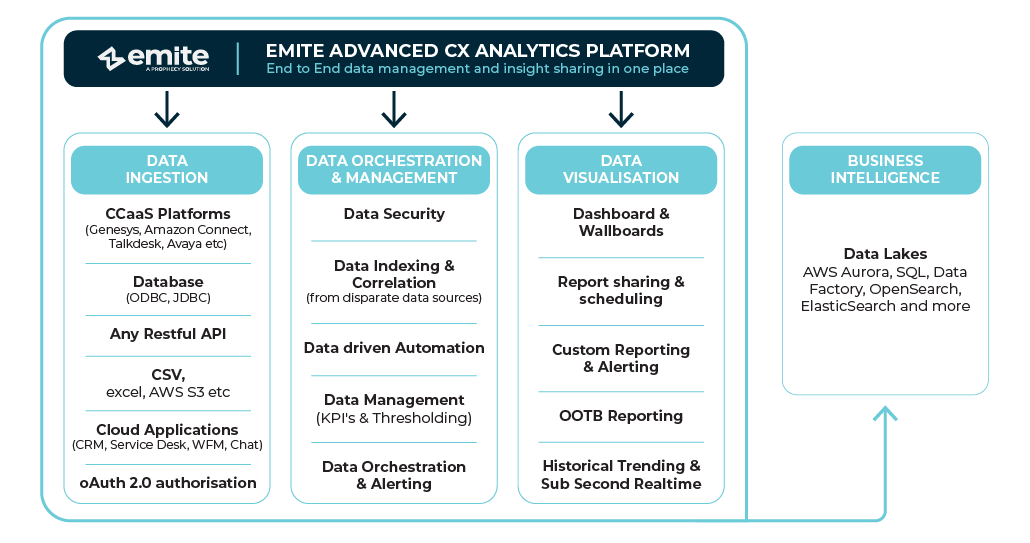
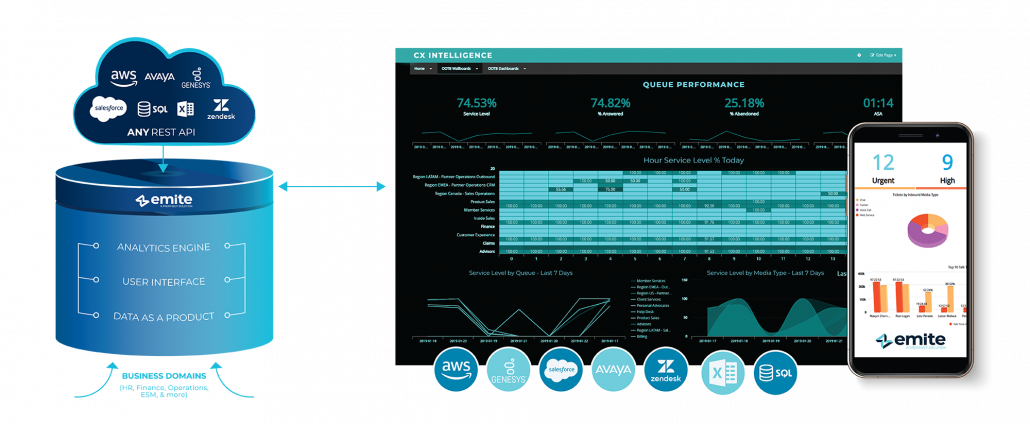
emite excels in optimizing contact centers, particularly in descriptive and diagnostic analytics. It provides comprehensive reporting and real-time data visualization, delivering detailed analysis of performance issues and offering actionable insights to drive improvements. emite’s strength lies in its ability to integrate real-time and historical data from various sources, ensuring precise guidance and enhancing efficiency and customer satisfaction. Additionally, emite has robust extract, transform, load (ETL) and data ingestion capabilities, ensuring seamless integration and comprehensive functionality without the need for additional solutions like Mulesoft, Prometheus, Redshift, and Athena.

Key features:

  • Descriptive analytics: comprehensive reporting and real-time data visualization to monitor performance and customer experience (CX).
  • Diagnostic analytics: advanced data correlation and key performance indicator (KPI) management, integrating real-time and historical data from multiple sources.
  • Prescriptive analytics: provides actionable insights to optimize contact center performance based on real-time data with definable thre
  • Predictive analytics: provides trusted data in a clean, user-friendly format for business intelligence teams, enhancing their predictive modeling efforts.

Tableau and Power BI are robust tools for creating detailed reports and dashboards, empowering users to summarize historical data and identify trends effectively. They support in-depth analysis through interactive dashboards and sophisticated querying capabilities.

Strengths:

  • Descriptive analytics: capable of creating detailed reports and dashboards.
  • Diagnostic analytics: supports in-depth analysis by helping users drill down into data to find root causes of issues.
  • Prescriptive analytics: integrates with optimization models and decision support systems to offer actionable recommendations.

Weaknesses:

  • Complexity: users often find Tableau and Power BI complex to set up, requiring substantial training for effective utilization.
  • Performance issues: some users encounter performance issues, particularly with large data sets, leading to slow and unresponsive performance.
  • Cost: both platforms can be costly, especially when scaling up with additional users and advanced features, making them less accessible for smaller businesses.
  • ETL and data ingestion: poor ETL and data ingestion capabilities, often requiring additional solutions to match the comprehensive functionality of a platform like emite.

Success KPI specializes in real-time insights and visualizations for contact centers, effectively summarizing performance metrics and trends. However, it has limitations in scope and customization compared to more versatile tools like emite, Tableau, and Power BI.

Strengths:

  • Descriptive analytics: specializes in real-time insights and visualizations for contact centers.
  • Diagnostic analytics: provides tools to analyze call data, customer interactions, and agent performance.

Weaknesses:

  • Limited scope: analytics capabilities are constrained compared to more versatile tools. May not meet the needs of organizations requiring broader business analytics beyond basic contact center operations.
  • Customization: users note fewer customization options, potentially limiting its flexibility in adapting to unique business requirements.
  • Prescriptive analytics: provides recommendations for improving agent performance and operational efficiency within contact centers. However, these capabilities are based on industry-wide standards or complex business rules, which can be challenging for organizations to prepare in advance.

How emite stands out

emite stands out for its specialization in contact centers, offering broad-reaching business insight  capabilities and seamless integrations that meet the end-to-end CX landscape. It provides unparalleled depth in descriptive and diagnostic analytics, real-time data integration, and actionable insights. emite goes beyond typical dashboarding tools to deliver powerful analysis and reporting capabilities, ensuring comprehensive support for optimizing contact center performance and enhancing customer experience. Its advanced features and integrations let organizations fully leverage their data for superior operational efficiency and customer satisfaction.

Key differentiators

Seamless integration

integrates well with broader data architecture, improving visibility, security, and consistency.

Advanced KPI management

enhanced monitoring and performance optimization.

Real-time data integration

ensures precise guidance and enhances efficiency and customer satisfaction.

emite often works in conjunction with Tableau and Power BI for other BI requirements, providing powerful analytics and insights with lower complexity.

How to get started

Understanding these analytics types provides the knowledge to leverage data effectively and make data-driven decisions to enhance business performance and customer satisfaction. Analytics is about understanding the questions that need to be asked, while dashboarding is about measuring the results. emite excels in both areas, providing comprehensive analytics to identify key questions and robust dashboarding to track results. By identifying where your organization faces challenges, emite can align its strengths to deliver tailored and efficient solutions, unlike tools such as Success KPI that only show the results.

Ready to optimize your contact center with emite’s powerful analytics?

emite
Privacy Overview

This website uses cookies so that we can provide you with the best user experience possible. Cookie information is stored in your browser and performs functions such as recognising you when you return to our website and helping our team to understand which sections of the website you find most interesting and useful.