
BLOG
Customer behaviour has changed faster than the systems designed to support it. Customers now expect seamless movement across voice, chat, social messaging, SMS, email, and digital channels — often switching channels multiple times within the same issue.
But inside most contact centres, each interaction lives in a different platform, a different dataset, and a different reporting world. This mismatch between customer reality and operational visibility is one of the biggest barriers to great service today.
This blog breaks down why omnichannel visibility is now a non-negotiable capability — and how contact centres can finally achieve it.

The Core Problem: Channels Don’t Share Context
Contact centres aren’t struggling because they lack data — they’re struggling because each platform uses:
- different identifiers
- different timestamps
- different definitions
- different interaction models
- different reporting refresh cycles
Customers don’t think in channels; they think in outcomes:
- They start on web chat while browsing a product.
- They escalate to voice when the issue becomes complex.
- The next day, they send a WhatsApp message to follow up.
- If unresolved, it becomes a case in CRM.
- A back-office team may complete the final steps in ServiceNow or Jira.
From the customer’s perspective, this is one journey.
From the business’ perspective?
It’s often five separate systems, none of which share context.
- A complaint might appear resolved in one system and still open in another.
- An SLA breach might be invisible because the data never lined up.
This creates fragmented journeys, misleading analytics, and inconsistent CX insights.
This is why omnichannel isn’t a technology challenge — it’s a data unification challenge.
The Fragmented Contact Centre Tech Stack
Modern contact centres operate across a wide ecosystem:
Voice & CCaaS
AWS Connect, Cisco UCCX/UCCE, Genesys Cloud & Engage, NICE CXone, Avaya, Five9
Digital & Messaging
Webchat, AI chatbots, WhatsApp, Messenger, SMS (Twilio, Pinpoint), email platforms
CRM & Case Management
Salesforce, Dynamics, ServiceNow, Zendesk, HubSpot
Workforce & QA
NICE, Verint, Calabrio, Playvox, Genesys WEM, QA scoring tools
Back-Office & Support Systems
Jira, ServiceNow, ERP systems, billing platforms
Each of these produces different datasets — different timestamps, identifiers, and interpretations of the journey.
Which means no one sees the whole journey.
Why Fragmented Channels Create Broken Experiences
1. Customers repeat themselves
Agents don’t have context from previous channels.
2. Insights don’t align across departments
WFM, QA, and operations each get a different picture.
3. AI and automation underperform
Machine learning models struggle when data is incomplete or siloed.
4. Leadership can’t identify root cause
Is the problem staffing? Channel deflection? Queue misrouting? Digital UX?
Hard to know when the data doesn’t line up.
5. Reporting becomes detective work
Analysts waste hours reconciling journeys manually.
This is why omnichannel isn’t just a technology challenge — it’s a data challenge.
The Shift From Multichannel to Omnichannel
Most contact centres today operate in a multichannel mode:
Multiple channels exist, but none are connected.
A modern contact centre must operate in true omnichannel mode:
Every interaction contributes to a unified, contextualised customer story.
This is where a unified data platform becomes essential.


Introducing the Intelligence Layer for Omnichannel: emite
emite sits across the entire contact centre ecosystem, unifying data from voice, digital, CRM, WFM, QA, and back-office platforms — without relying on dozens of vendor-specific connectors.
Here’s how emite solves omnichannel fragmentation:
1. Connector-Less Integration Across Every Platform
emite ingests structured and unstructured data from:
- CCaaS platforms
- Messaging APIs
- CRM systems
- WFM & QA systems
- Interaction analytics
- Support workflows
- Custom internal systems
This removes reliance on vendor limitations and ensures every channel can be integrated.

2. Correlating Interactions Into a Single Customer Journey
Using identifiers, metadata, timestamps, and AI-based inference, emite correlates events across systems into a unified journey timeline:
Voice + Chat + Email + WhatsApp + CRM + QA + Back-office
→ Finally visible as one experience.
No more channel silos.
No more missing context.

3. Normalising Metrics for Consistent Reporting
emite ensures that metrics mean the same thing across platforms:
- AHT
- ASA
- FCR
- Abandonment
- Resolution time
- Transfer rates
- Sentiment
- Conversation duration
Leadership can compare channels confidently without trying to align definitions manually.

4. Advanced Visualisation for Omnichannel Intelligence
emite visualises the entire operation:
- Omnichannel volume trends
- Journey bottlenecks
- Channel shift analysis
- Digital → Voice escalation paths
- Agent performance across all channels
- Real-time SLA tracking
- CX outcome analysis
Leaders see exactly where breakdowns occur — and why.

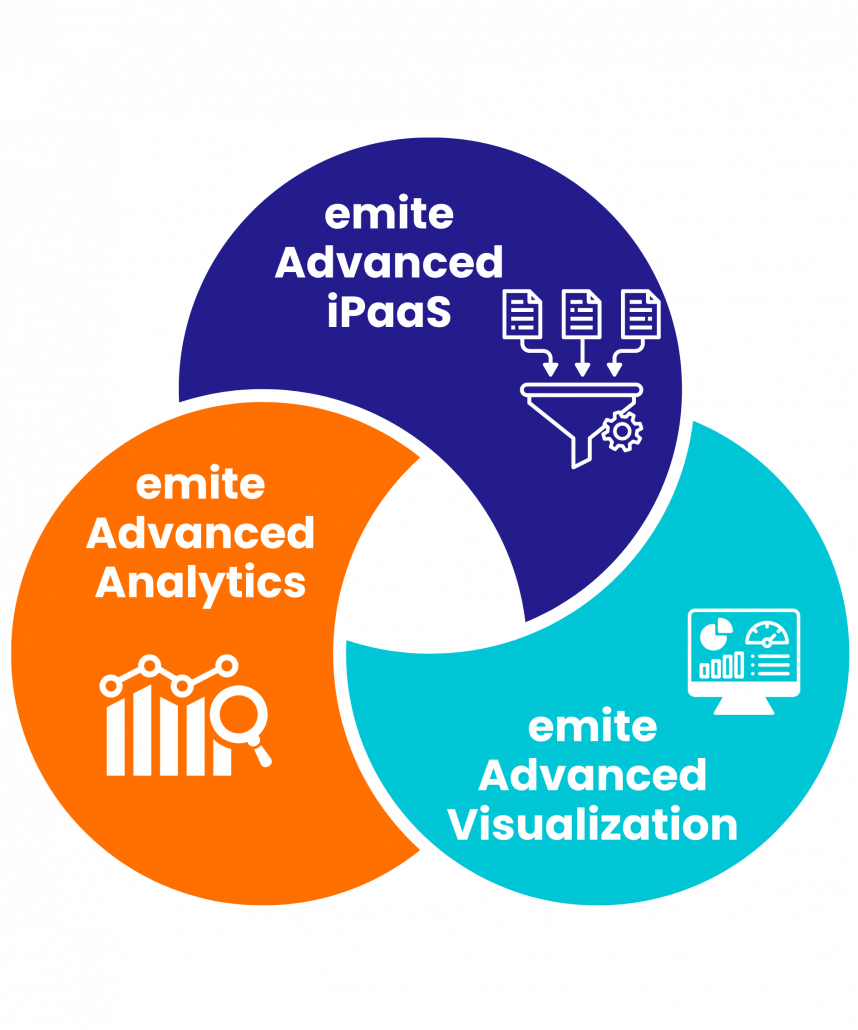
5. Event-Driven Workflows With emite Advanced iPaaS
Insights don’t just inform decisions — they automate them:
- Trigger follow-up tasks when sentiment drops
- Auto-create cases when journeys stall
- Alert supervisors when queues hit thresholds
- Push insights directly into WFM, CRM, or routing engines
- Automate escalations between front line and back office
This transforms omnichannel analytics into omnichannel action.

How emite Fixes Omnichannel Fragmentation
Omnichannel only works when the data is unified, contextualised, and correlated in real time.
emite solves this by:
✓ Unifying voice, digital, CRM, and WFM data in a single platform
Connector-less integration ingests structured and unstructured data across every CCaaS, CRM, and digital channel — without relying on vendor-specific connectors.
✓ Correlating events across platforms into a single journey timeline
emite links interactions using identifiers, metadata, and AI-driven inference to produce a complete customer journey across voice, chat, email, and social.
✓ Normalising metrics so every channel speaks the same language
AHT is AHT everywhere.
Abandonment is abandonment everywhere.
Definitions are finally consistent.
✓ Visualising omnichannel KPIs with Advanced Visualisation
Leaders can see channel comparisons, journey bottlenecks, customer sentiment, and agent performance across the entire operation — in real time.
✓ Powering workflows with emite Advanced iPaaS
Routing logic becomes more effective.
Escalations can trigger automatically.
Customer insights can push directly into CRM or WFM.

What True Omnichannel Looks Like With emite
Imagine this flow — all stitched together:
- Customer starts on web chat
- Bot escalates to voice via AWS Connect
- Agent logs notes in Salesforce
- Customer follows up via WhatsApp
- Issue is escalated via ServiceNow
- QA reviews the conversation in NICE
- WFM updates intraday staffing based on spikes detected in chat volume
In most contact centres, this becomes seven systems = seven disconnected journeys.
With emite?
It becomes one customer, one timeline, one truth.
The Bottom Line: Omnichannel Isn’t Optional — It’s Advantage
As digital engagement rises and customer expectations accelerate, the contact centres that win will be the ones that can:
- See every interaction
- Understand every journey
- Predict every outcome
- Act in real time
- Automate intelligently
All of that starts with a unified data layer.
And that’s exactly what emite delivers.