
BLOG
Most conversations about AI in business still treat it as something on the horizon. A capability being evaluated, piloted, or planned for. The reality in 2026 is different.
AI is already embedded across most organisations. In some functions it is deeply integrated, automating workflows, accelerating analysis, supporting customer interactions. Most apps in the tech stack have enabled AI capability as part of its latest release. In others it is being used informally, by individuals, without governance or visibility from the centre. And in almost every case, the gap between how much potential the organisation believes AI holds and how much value it is actually extracting is significant.
This is not primarily a technology problem. The tools are mature, accessible, and increasingly affordable. The gap exists because most organisations have focused on AI adoption without first asking the more important question:
What does AI actually need to work well, do we have it and basically are we really leveraging the true value of the application?
This blog is a practical answer to that question. It looks at where and how AI genuinely accelerates value, why the human element becomes more important as AI capability grows, and what the data foundation underneath needs to look like to make AI outputs trustworthy and defensible.

WHERE AI GENERATES REAL, PRACTICAL VALUE
-
Task Acceleration: Giving Time Back to the People Who Know How to Use It
The most immediate and universal value AI delivers is speed. Tasks that previously consumed significant analyst or management time can now be completed in a fraction of it.
This includes: compiling and summarising data across multiple sources, producing first-draft reports and frameworks, generating structured analysis from unstructured inputs, building scenario models, and creating initial recommendations from large data sets.
None of this eliminates the need for expertise. It changes where that expertise is applied.
Instead of spending three hours pulling together a weekly performance report, an analyst spends thirty minutes reviewing, interrogating, and adding the contextual interpretation that only someone with knowledge of the business can provide. Instead of a manager spending a morning preparing a board presentation from scratch, they spend that morning refining, challenging, and strengthening a first draft that AI produced in minutes.
The value is not in removing human time from the process. It is in redirecting human time toward the parts of the process where it creates the most value, judgement, interpretation, and decision-making.
Forrester’s research on data and analytics architecture highlights this shift: organisations moving up the AI maturity curve are using automation not to replace analytical capability, but to elevate it, creating the conditions for faster, more sophisticated insight at every level of the business.
-
Insight Generation: Moving From Reporting to Analysis
Traditionally, the journey from raw data to business insight has been slow. Data is extracted, cleaned, formatted, and reported, by which point it describes a moment that has already passed. Analysis, the actual examination of what the data means and what should be done about it, happens later, if at all.
AI compresses this dramatically.
Natural language querying allows business users to interrogate data directly, without specialist technical skills. Pattern recognition surfaces relationships and anomalies that manual analysis would miss or take weeks to identify. Predictive modelling generates forward-looking scenarios that inform decisions before conditions change.
The result is that more people across the business can engage with data more deeply, more frequently, and more meaningfully. Not just the data team. Not just senior leadership. Operations managers, customer experience leads, finance business partners, all gain access to analytical capability that was previously gated behind technical expertise or reporting cycles.
MIT Sloan Management Review research has consistently found that the organisations generating the most sustained value from analytics are those where data-informed decision-making is distributed across the business, not siloed in a central function. AI is the mechanism that makes that distribution practical at scale.


-
AI as a Data Quality Engine: Using AI to Fix the Foundation
This is one of the most underutilised and most valuable applications of AI in a business context, and it changes the conversation about data quality entirely.
Most organisations have data quality challenges.
- Incomplete records.
- Inconsistent definitions.
- Integration gaps between systems.
- Fields populated differently across teams.
These are the everyday reality of operating complex businesses on multiple platforms over many years. The traditional response has been to treat data quality improvement as a prerequisite for AI adoption: fix the data, then deploy the AI. Whether we are talking about AI apps or not, the old adage still applies “Garbage in – Garbage out”
The more practical approach is to reverse that sequence: use AI to help fix the data.
AI-powered profiling tools can scan data environments and surface where records are incomplete, where field definitions are inconsistent, where integration between systems is failing, and where data is being captured differently across teams. Rather than a manual audit that takes months, this analysis can happen rapidly and continuously, generating a clear, prioritised picture of where data quality issues exist and what their downstream impact is likely to be.
From there, AI can go further: generating recommended remediation frameworks, drafting data governance documentation, proposing standard definitions, and flagging where business rules need to be agreed and enforced. What was previously a major project requiring specialist data governance resource becomes an accelerated, structured process,
This creates a compounding feedback loop. Better data quality produces more reliable AI outputs. More reliable AI outputs build trust and confidence in AI-assisted workflows. Greater confidence drives deeper adoption. And deeper adoption generates more opportunity to surface and address the next layer of data quality issues.
The organisations waiting for perfect data before deploying AI will wait a long time. The organisations using AI to actively improve their data will reach that foundation faster, and be extracting value throughout the journey.
THE HUMAN ELEMENT: MORE IMPORTANT, NOT LESS
As AI capability grows, a common concern is that human expertise will become less relevant. The practical experience of organisations deploying AI at scale suggests the opposite is true.
Human expertise does not become less important when AI is involved. It becomes more consequential.
Here is why. AI generates outputs at speed and scale. It surfaces patterns, drafts frameworks, produces analysis, and makes recommendations faster than any human team could. But every one of those outputs requires a human to determine whether it is correct, contextually appropriate, and genuinely useful.
The more you use it, ingest better data, refine its learning, the better AI gets at producing plausible-sounding outputs, it then becomes more important to have people with deep domain knowledge to continue to evaluate them and continue to maximise its use.


Experience Is the Prompt
The quality of an AI output is directly shaped by the quality of the prompt and data that produced it. And writing a genuinely good prompt is not a technical skill, it is a domain skill.
A prompt that produces a useful competitive analysis requires someone who understands what a good competitive analysis looks like, what dimensions matter for this particular business, and what outcome the analysis is meant to inform. A prompt that produces a useful data quality remediation framework requires someone who understands how data flows through the organisation, where the priority issues sit, and what good looks like in this context.
The experience and knowledge that took years to accumulate does not become redundant when AI enters the workflow. It becomes the input that shapes what AI produces.
Expertise Is the Accelerator — Not the Gatekeeper
AI does not need to be fully understood to be useful. That is one of its most powerful qualities.
A contact centre analyst who has never built a statistical model can ask an AI system why handle times spiked on Tuesday. A team leader without a data science background can ask which agents are showing early signs of disengagement. A new hire three weeks into their role can ask what good looks like in this queue and get a meaningful, contextual answer.
This is the opportunity that gets missed in most conversations about AI and expertise: Although SME’s can get the best from AI, AI is not just a tool for experts. It is a tool that used well can create them.
When people interact with AI to ask questions, explore patterns, and interrogate outcomes, they are learning. They are building intuition about what the data means, what questions are worth asking, and what a reasonable answer looks like. Over time, that interaction closes the gap between those who know the business deeply and those who are still finding their feet, faster than ever before.
The organisations getting this right are using AI in two directions at once:
- Experienced people use AI to go further — deeper analysis, faster synthesis, broader pattern recognition across data sets they could not manually review
- Less experienced people use AI to grow faster — guided questioning, contextual recommendations, and real-time feedback that accelerates the learning curve
Both outcomes compound. And both require the same foundation: clean, trusted, well-governed data.
Where expertise remains irreplaceable is in directing AI — shaping the questions, evaluating the outputs, and standing behind the decisions. Experienced people bring the right context to determine when a pattern is meaningful, when a recommendation is workable, and when an output is technically sound but misses a critical nuance that only someone who knows this organisation would catch.
This is not a constraint on what AI can do. It is the productive division of labour between human judgement and machine capability as it grows and learns.
Experienced people bring:
- The right questions, shaped by years of business and domain knowledge
- The context to evaluate whether an answer is genuinely useful or directionally plausible but practically wrong
- The accountability to act — or not act — on what AI surfaces
- The ability to explain and defend a decision to leadership, customers, or regulators
AI brings:
- Scale and speed across large, complex data sets
- Pattern recognition that surfaces what humans might miss
- Recommendations that give less experienced people a starting point, and insight — not a final answer
- Consistency across analysis that reduces individual bias
Together, they produce something neither can achieve alone in real-time: confident, explainable, accountable decisions made at the speed the business requires.

Building Better People — Not Just Better Outputs
The most under-valued return on AI investment is not efficiency. It is capability development.
When a less experienced team member interacts with a well-designed AI system, one backed by clean data and governed KPI logic, they are not just getting an answer. They are being shown how to think about the problem. They see which variables matter. They observe how context changes the interpretation. They learn, through repeated interaction, what good analysis looks like in this business, for this metric, in this context.
This is how organisations close the expertise gap without waiting years for it to close on its own. AI, used well, is a continuous development environment for everyone who touches it.

THE DATA FOUNDATION: WHAT MAKES AI DEFENSIBLE
All of this, the task acceleration, the insight generation, the data quality improvement, the human-AI collaboration, depends on one thing: a data foundation that AI can work with reliably.
AI accelerates and amplifies, but it does not discriminate between inputs. Feed it consistent, well-governed, contextually rich data and it will produce outputs that are faster, more nuanced, and more trustworthy than manual analysis. Feed it fragmented, inconsistently defined, poorly integrated data and it will reach the wrong answer more efficiently.
Gartner research is unambiguous on the investment profile of organisations achieving genuine AI value: those with high AI maturity invest up to four times more in foundational areas, data quality, governance, and the human capability to work with AI effectively, and achieve up to 65% greater business outcomes as a result. The investment that drives AI value is not in the model. It is in what surrounds it.
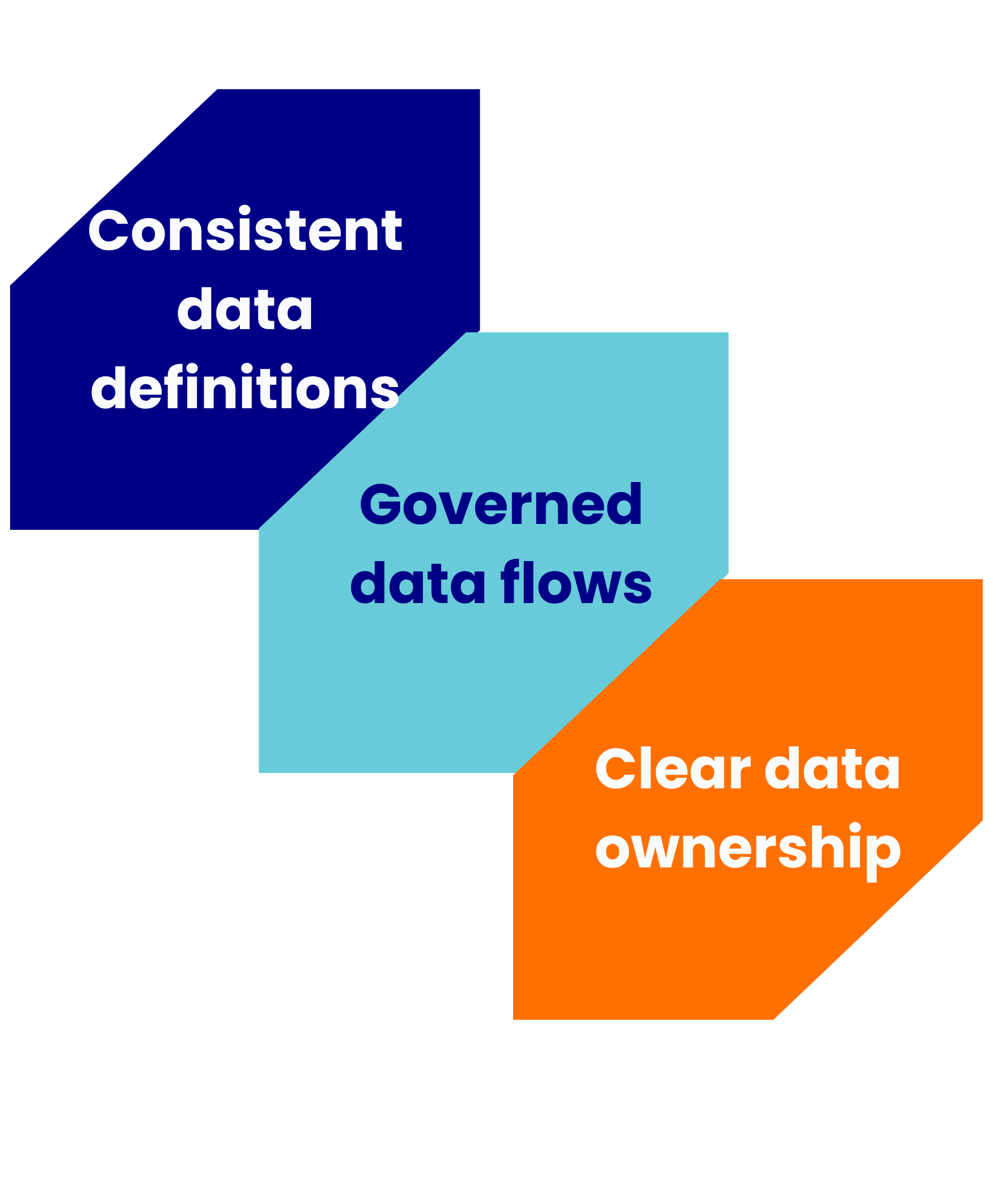
The Three Foundations That Make AI Work
Consistent data definitions.
When every team uses the same definition of revenue, customer, or satisfaction, AI can analyse across those teams and produce insight that is genuinely comparable and aggregable. When definitions differ, AI analysis produces outputs that are internally inconsistent, and the inconsistency is often invisible until a decision based on that output is challenged.
Governed data flows.
AI needs to know where data comes from, how it has been transformed, and what rules have been applied to it. Without this, outputs cannot be explained or audited. And in regulated environments, or any environment where decisions need to be justified, unexplainable outputs are not usable outputs.
Clear data ownership.
Someone needs to be accountable for the accuracy and relevance of the data AI is working with. Not just who stores it, who is responsible for what it produces. When AI surfaces an anomaly, there needs to be a person who can determine what it means and decide what to do about it. Accountability is what converts AI output into organisational action.
These are not governance requirements imposed from outside. They are operational requirements for anyone who wants AI to deliver reliable, defensible, and sustained value.

PUTTING IT TOGETHER: A PRACTICAL AI VALUE FRAMEWORK
For organisations looking to move from ad hoc AI use to systematic AI value, the practical framework looks like this:
-
Start with use cases, not technology.
Identify where in the business AI could redirect human time most valuably, the tasks that consume disproportionate time relative to the insight they produce. These are the highest-return starting points.
-
Invest in prompting capability.
Train the people who will work with AI outputs to write effective prompts, grounded in domain knowledge, aligned to expected outcomes, and specific enough to produce useful results. This is a skill, and it is learnable.
-
Use AI to profile your data.
Before treating data quality as a prerequisite for AI deployment, use AI to accelerate the assessment of where your data quality issues sit. This generates a faster, clearer picture of what needs to be fixed and in what order.
-
Build evaluation into the workflow.
Every AI output should pass through a human evaluation step before it informs a decision. Define what good looks like for each use case, and build the habit of checking outputs against that standard rather than accepting them at face value.
-
Establish the governance foundations progressively.
You do not need a perfect data foundation before you start. You need a clear direction, defined ownership, and a commitment to improving the foundation as you go. The organisations that wait for perfect conditions before deploying AI are the ones that fall furthest behind.

THE BOTTOM LINE
AI is generating real, practical value for organisations right now, in task acceleration, insight generation, and data quality improvement. That value is not contingent on having perfect data or a complete AI strategy. It is available today, to organisations at every stage of maturity.
What it does require is the right combination of human expertise and data foundation. The organisations winning with AI are not those with the most sophisticated technology. They are those with people who know how to work with it effectively, and data that gives it something reliable to work with.
That combination, capable people, trustworthy data, and a governance model that makes outputs defensible, is what separates AI as a genuine business capability from AI as an experiment that never quite delivers.
Speak to an emite specialist about building the data foundation that makes AI work reliably for your organisation.
RELATED RESOURCES