
USE CASE
Delivering AI Observability and Decision Accountability in Utilities
Background
A national utilities provider expanded its use of advanced analytics and AI across outage prediction, demand forecasting, asset management, emissions reporting, and customer vulnerability monitoring.
While AI demonstrated strong internal performance improvements, regulatory expectations were evolving rapidly. Regulators including bodies such as Ofgem and equivalent global authorities — are increasing oversight of AI systems influencing:
- Grid reliability
- Public safety
- Customer affordability
- Decarbonisation compliance
- Performance-based regulatory metrics
Utility AI now shapes decisions that affect regulated outcomes. Regulators are increasingly assessing not only performance, but the governance, traceability, and resilience of the systems producing those outcomes.

The Regulatory Challenge
The organisation faced a complex operational and regulatory landscape:
- Legacy SCADA and operational systems were not designed for modern integration.
- Data feeding AI models originated from fragmented telemetry, field logs, asset systems, and customer platforms.
- Cyber resilience requirements were intensifying.
- Performance-Based Regulation (PBR) models required measurable contribution to reliability, cost efficiency, and customer experience.
- Climate and green transition mandates required transparent emissions and grid planning reporting.
- Regulators were requesting clearer documentation of decision processes influencing asset prioritisation and outage response.
AI models were performing — but the organisation lacked unified visibility into how decisions were formed across legacy and modern systems.
Operationally effective.
Regulatorily exposed.
Aligning AI Observability with Energy Sector Regulation & EU AI Act Expectations
Utilities operate in highly regulated environments where operational decisions must be transparent, defensible, and auditable.
As AI becomes embedded in outage prediction, demand forecasting, and asset prioritisation, regulatory expectations increasingly extend to how decisions are informed — not just the outcomes.
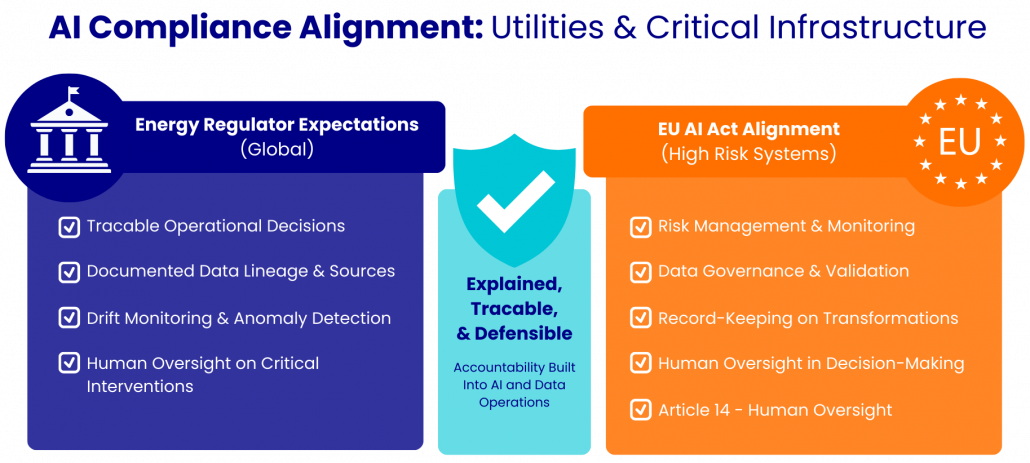
Energy Regulator Expectations
Utilities are increasingly expected to demonstrate:
1.AI Governance & Lifecycle Risk Management
Documented oversight of AI systems, lifecycle risk assessment, and explainability aligned with frameworks such as the EU AI Act and global AI governance principles.
2.Cybersecurity & Operational Resilience
Integrated monitoring, anomaly detection, and incident response capabilities across operational technology (OT) and IT environments.
3.Performance-Based Regulatory Alignment
Evidence that AI-assisted decisions measurably contribute to:
- Reliability targets
- Service level performance
- Affordability metrics
- Customer vulnerability protections
4.Climate & Decarbonisation Accountability
Transparent reporting and defensible system planning aligned to emissions reduction and grid modernisation mandates.
Regulators now measure process integrity, not just performance output.
🇪🇺 EU AI Act Alignment
Where AI systems influence critical infrastructure or public services, they may fall under “high-risk” classifications within the EU AI Act.
The observability framework supported key provisions including:

Article 9 – Risk Management Systems
Ongoing monitoring of AI-assisted operational decisions.

Article 10 – Data Governance & Quality
Controlled, validated telemetry data feeding predictive models.
Article 12 – Record-Keeping & Logging
Traceable transformation and processing logs.

Article 14 – Human Oversight
Human approval embedded in high-impact operational interventions.

Article 15 – Accuracy & Robustness
Drift detection and anomaly monitoring across data inputs.
Required Outcomes:
To scale AI responsibly in this environment, the utility required:
- End-to-end traceability from raw telemetry and customer data through to AI-assisted recommendations.
- Governance guardrails embedded in operational workflows.
- Monitoring and anomaly detection across legacy SCADA and modern API-driven systems.
- Human-in-the-loop safeguards for high-impact interventions.
- Audit-ready documentation of transformation logic and decision thresholds.
- Evidence that AI outputs supported regulated performance metrics.
AI needed to move from “predictive capability” to “defensible operational infrastructure.

How the emite Platform Helped
The emite Platform provided the observability and governance layer required to align AI deployment with regulatory expectations.
Unified Visibility Across Legacy & Modern Systems
Using emite Advanced iPaaS, data from legacy SCADA environments, operational databases, IoT telemetry, and customer systems was ingested and contextualised — even where systems were not originally designed for interoperability.
Governance Embedded by Design
Human-defined, auditable business rules were applied during processing to align predictive scoring with regulated performance metrics, cost controls, and service obligations.
Drift & Anomaly Detection
Monitoring across ingestion and transformation layers enabled early detection of:
- Sensor recalibration impacts
- Data latency anomalies
- Behavioural shifts in predictive outputs
Reducing regulatory exposure tied to silent model drift.
Decision Traceability & Regulatory Defence
AI-assisted operational recommendations were traceable back to source data, applied rules, and governance controls — supporting audit review, regulatory submissions, and executive assurance.
AI decisions became explainable, defensible, and aligned to regulated outcomes
Why Observability & Accountability Matter
Utilities that succeed in scaling AI will not simply optimise operations — they will demonstrate:
- Traceable decision processes
- Embedded governance controls
- Cyber-resilient monitoring frameworks
- Performance defensibility against regulatory scrutiny
- Climate and affordability accountability
AI becomes not a black-box efficiency tool but a regulated, transparent operational asset.
Regulatory & Operational Impact Snapshot
- ↑ Improved traceability for regulatory review cycles
- ↑ Demonstrable alignment between AI outputs and PBR metrics
- ↓Reduced drift-related operational exposure
- ↑ Greater confidence in emissions and grid planning reporting
- ↑ Enhanced visibility across legacy OT and modern IT data flows
- ✓ Embedded human oversight for high-impact interventions
Executive Takeaway
In modern utilities, innovation is judged by regulators as much as by operations.
AI that cannot be explained cannot be defended.
And AI that cannot be defended cannot scale.